World supplier of antibodies, antigens and kits since 2007

Primary Antibodies
cIAP2 (1F12) Mouse mAb
$255/ 100ul
QuantityTotal: $255
Ship worldwide. Contact order@enogene.com for ordering and bulk pricing or contact your local distributor.
Form Or Antibody
Form of AntibodyLiquid in PBS containing 50% glycerol, 0.5% BSA and 0.02% sodium azide, pH 7.3.
Specificty Sensitivity
Specificity/SensitivityThis antibody detects endogenous levels of BIRC3 and does not cross-react with related proteins.
Product Information
Entrez summaryThis gene encodes a member of the IAP family of proteins that inhibit apoptosis by binding to tumor necrosis factor receptor-associated factors TRAF1 and TRAF2, probably by interfering with activation of ICE-like proteases.The encoded protein inhibits apoptosis induced by serum deprivation but does not affect apoptosis resulting from exposure to menadione,a potent inducer of free radicals.It contains 3 baculovirus IAP repeats and a ring finger domain.Transcript variants encoding the same isoform have been identified.
UniPort summary FunctionMulti-functional protein which regulates not only caspases and apoptosis,but also modulates inflammatory signaling and immunity,mitogenic kinase signaling and cell proliferation,as well as cell invasion and metastasis.Acts as an E3 ubiquitin-protein ligase regulating NF-kappa-B signaling and regulates both canonical and non-canonical NF-kappa-B signaling by acting in opposite directions:acts as a positive regulator of the canonical pathway and suppresses constitutive activation of non-canonical NF-kappa-B signaling.The target proteins for its E3 ubiquitin-protein ligase activity include: RIPK1,RIPK2,RIPK3,RIPK4,CASP3,CASP7,CASP8,TRAF1,and BCL10.Acts as an important regulator of innate immune signaling via regulation of Toll-like receptors(TLRs),Nodlike receptors (NLRs) and RIG-I like receptors (RLRs),collectively referred to as pattern recognition receptors (PRRs).Protects cells from spontaneous formation of the ripoptosome,a large multi-protein complex that has the capability to kill cancer cells in a caspase-dependent and caspase-independent manner.Suppresses ripoptosome formation by ubiquitinating RIPK1 and CASP8.
IsotypeIgG1
Molecular WeightCalculated MW: 68 kDa; Observed MW: 72 kDa
UniProt NumberQ13489
Gene symbolAIP1; API2; MIHC; CIAP2; HAIP1; HIAP1; MALT2; RNF49; c-IAP2
Product TypePrimary Antibody
Clone Number1F12-E5-G12
Recommended DilutionsWB: 1/500-1/1000
ImmunogenPurified recombinant human c-IAP2 protein fragments expressed in E.coli
Antibody typeMonoclonal Antibody
PurificationAffinity Purified
Cellular localizationCytoplasm.Nucleus
Gene ID330
All Names
AlternamecIAP2; AIP1; API2; BIRC3; CIAP2; HAIP1; IAP homolog C; RNF49; MIHC; MALT2; Apoptosis inhibitor 2; IAP2
Price255$
Research AreaAutophagy antibody Cancer Cardiovascular Cell Biology Epigenetics & Nuclear Signaling Developmental Biologys Immunology Drug Discovery Products Metabolism Neuroscience Signal Transduction Stem Cells
BackgroundApoptotic suppressor. The BIR motifs region interacts with TNF receptor associated factors 1 and 2 (TRAF1 and TRAF2) to form an heteromeric complex, which is then recruited to the tumor necrosis factor receptor 2 (TNFR2).
Gene NameBIRC3
Storage/StabilityStore at 4°C short term. Aliquot and store at -20°C long term. Avoid freeze/thaw cycles.
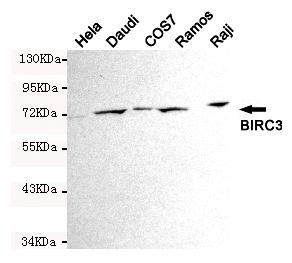
detection of BIRC3 in Ramos,COS7,Raji&Daudi cell lysates using BIRC3 band size: 68KDa,Observed band size:72KDa.
Conjugated Antibody
This product is also available conjugated. Format: E2200766-Conjugate. Price: $485 / Size: 100μl.
E2200766-FITC$485 / 100μlE2200766-Biotin$485 / 100μlE2200766-HRP$485 / 100μlE2200766-AP$485 / 100μlE2200766-AF350$485 / 100μlE2200766-AF405M$485 / 100μlE2200766-AF488$485 / 100μlE2200766-AF514$485 / 100μlE2200766-AF532$485 / 100μlE2200766-AF555$485 / 100μlE2200766-AF568$485 / 100μlE2200766-AF405S$485 / 100μlE2200766-AF405L$485 / 100μlE2200766-AF546$485 / 100μlE2200766-AF594$485 / 100μlE2200766-AF610$485 / 100μlE2200766-AF635$485 / 100μlE2200766-AF647$485 / 100μlE2200766-AF680$485 / 100μlE2200766-AF700$485 / 100μlE2200766-AF750$485 / 100μlE2200766-AF790$485 / 100μlE2200766-APC$485 / 100μlE2200766-PE$485 / 100μlE2200766-Cy3$485 / 100μlE2200766-Cy5$485 / 100μlE2200766-Cy5.5$485 / 100μlE2200766-Cy7$485 / 100μlE2200766-PE-Cy5$485 / 100μl
Contact order@enogene.com to order conjugated formats. Magnetic Beads (1-30μm) conjugation is also available.


Categories by research area
Categories by product type
- Antibodies
- Primary Antibodies
- Tag antibodies
- Internal control antibodies
- Pathological (Immunohistochemistry, IHC) antibodies
- Cell Signal Transduction Research Antibodies
- Secondary Antibody
- Antibody Sampler Kits
- ELISA Kits
- Recombinant Proteins
- Fluorescence Reagents
- Signal Inhibitors and Activators
- Transfection Reagent
- Cell biology kits
- Overexpression Cell Lines
- Cell Lysates
- Purification Resins
- 2019-nCoV & Monkeypox