World supplier of antibodies, antigens and kits since 2007

Primary Antibodies
CRK (3H7) Mouse mAb
$255/ 100ul
QuantityTotal: $255
Ship worldwide. Contact order@enogene.com for ordering and bulk pricing or contact your local distributor.
Form Or Antibody
Form of AntibodyLiquid in PBS containing 50% glycerol, 0.5% BSA and 0.02% sodium azide, pH 7.3.
Specificty Sensitivity
Specificity/SensitivityThis antibody detects endogenous levels of CRK and does not cross-react with related proteins.
Product Information
Entrez summaryThis gene encodes a member of an adapter protein family that binds to several tyrosine-phosphorylated proteins. The product of this gene has several SH2 and SH3 domains (src-homology domains) and is involved in several signaling pathways, recruiting cytoplasmic proteins in the vicinity of tyrosine kinase through SH2-phosphotyrosine interaction. The N-terminal SH2 domain of this protein functions as a positive regulator of transformation whereas the C-terminal SH3 domain functions as a negative regulator of transformation. Two alternative transcripts encoding different isoforms with distinct biological activity have been described.
UniPort summary FunctionThe Crk-I and Crk-II forms differ in their biological activities. Crk-II has less transforming activity than Crk-I. Crk-II mediates attachment-induced MAPK8 activation, membrane ruffling and cell motility in a Rac-dependent manner. Involved in phagocytosis of apoptotic cells and cell motility via its interaction with DOCK1 and DOCK4. May regulate the EFNA5-EPHA3 signaling.
IsotypeIgG2b
Molecular WeightCalculated MW: 34 kDa; Observed MW: 34 kDa
UniProt NumberP46108
Gene symbolp38; CRKII
Product TypePrimary Antibody
Clone Number3H7-E5-H8
Recommended DilutionsWB: 1/500-1/1000
ImmunogenPurified recombinant human CrkII protein fragments expressed in E.coli.
Antibody typeMonoclonal Antibody
PurificationAffinity Purified
Cellular localizationCytoplasm, Cell membrane
Gene ID1398
All Names
AlternameAdapter molecule crk; avian sarcoma virus CT10 (v-crk) oncogene homolog; CRK; CRKII; Proto-oncogene c-Crk
Price255$
Research AreaAutophagy antibody Cancer Cardiovascular Cell Biology Epigenetics & Nuclear Signaling Developmental Biologys Immunology Drug Discovery Products Metabolism Neuroscience Signal Transduction Stem Cells
BackgroundThe Crk-I and Crk-II forms differ in their biological activities. Crk-II has less transforming activity than Crk-I. Crk-II mediates attachment-induced MAPK8 activation, membrane ruffling and cell motility in a Rac-dependent manner. Involved in phagocytosis of apoptotic cells and cell motility via its interaction with DOCK1 and DOCK4. May regulate the EFNA5-EPHA3 signaling.
Gene NameCRK
Storage/StabilityStore at 4°C short term. Aliquot and store at -20°C long term. Avoid freeze/thaw cycles.
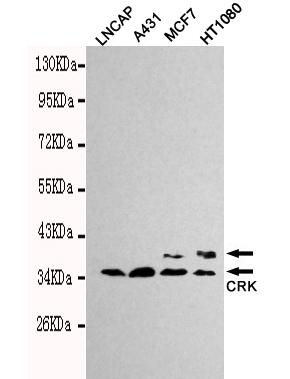
blot detection of CRK in LNCAP,A431,MCF7&HT1080 cell lysates (1:1000 diluted). Predicted band size: 34kDa Observed band size:
Conjugated Antibody
This product is also available conjugated. Format: E2200764-Conjugate. Price: $485 / Size: 100μl.
E2200764-FITC$485 / 100μlE2200764-Biotin$485 / 100μlE2200764-HRP$485 / 100μlE2200764-AP$485 / 100μlE2200764-AF350$485 / 100μlE2200764-AF405M$485 / 100μlE2200764-AF488$485 / 100μlE2200764-AF514$485 / 100μlE2200764-AF532$485 / 100μlE2200764-AF555$485 / 100μlE2200764-AF568$485 / 100μlE2200764-AF405S$485 / 100μlE2200764-AF405L$485 / 100μlE2200764-AF546$485 / 100μlE2200764-AF594$485 / 100μlE2200764-AF610$485 / 100μlE2200764-AF635$485 / 100μlE2200764-AF647$485 / 100μlE2200764-AF680$485 / 100μlE2200764-AF700$485 / 100μlE2200764-AF750$485 / 100μlE2200764-AF790$485 / 100μlE2200764-APC$485 / 100μlE2200764-PE$485 / 100μlE2200764-Cy3$485 / 100μlE2200764-Cy5$485 / 100μlE2200764-Cy5.5$485 / 100μlE2200764-Cy7$485 / 100μlE2200764-PE-Cy5$485 / 100μl
Contact order@enogene.com to order conjugated formats. Magnetic Beads (1-30μm) conjugation is also available.


Categories by research area
Categories by product type
- Antibodies
- Primary Antibodies
- Tag antibodies
- Internal control antibodies
- Pathological (Immunohistochemistry, IHC) antibodies
- Cell Signal Transduction Research Antibodies
- Secondary Antibody
- Antibody Sampler Kits
- ELISA Kits
- Recombinant Proteins
- Fluorescence Reagents
- Signal Inhibitors and Activators
- Transfection Reagent
- Cell biology kits
- Overexpression Cell Lines
- Cell Lysates
- Purification Resins
- 2019-nCoV & Monkeypox