World supplier of antibodies, antigens and kits since 2007

Primary Antibodies
CDK5 (2E8) Mouse mAb
$255/ 100ul
QuantityTotal: $255
Ship worldwide. Contact order@enogene.com for ordering and bulk pricing or contact your local distributor.
Form Or Antibody
Form of AntibodyLiquid in PBS containing 50% glycerol, 0.5% BSA and 0.02% sodium azide, pH 7.3.
Specificty Sensitivity
Specificity/SensitivityThis antibody detects endogenous levels CDK5(N-terminus) and does not cross-react with related proteins.
Product Information
Entrez summaryCdks (cyclin-dependent kinases) are heteromeric serine/threonine kinases that control progression through the cell cycle in concert with their regulatory subunits, the cyclins. Although there are 12 different cdk genes, only 5 have been shown to directly drive the cell cycle (Cdk1, -2, -3, -4, and -6). Following extracellular mitogenic stimuli, cyclin D gene expression is upregulated. Cdk4 forms a complex with cyclin D and phosphorylates Rb protein, leading to liberation of the transcription factor E2F. E2F induces transcription of genes including cyclins A and E, DNA polymerase and thymidine kinase. Cdk4-cyclin E complexes form and initiate G1/S transition. Subsequently, Cdk1-cyclin B complexes form and induce G2/M phase transition. Cdk1-cyclin B activation induces the breakdown of the nuclear envelope and the initiation of mitosis. Cdks are constitutively expressed and are regulated by several kinases and phosphastases, including Wee1, CDK-activating kinase and Cdc25 phosphatase. In addition, cyclin expression is induced by molecular signals at specific points of the cell cycle, leading to activation of Cdks. Tight control of Cdks is essential as misregulation can induce unscheduled proliferation, and genomic and chromosomal instability. Cdk4 has been shown to be mutated in some types of cancer, whilst a chromosomal rearrangement can lead to Cdk6 overexpression in lymphoma, leukemia and melanoma. Cdks are currently under investigation as potential targets for antineoplastic therapy, but as Cdks are essential for driving each cell cycle phase, therapeutic strategies that block Cdk activity are unlikely to selectively target tumor cells.
UniPort summary FunctionProbably involved in the control of the cell cycle. Interacts with D1 and D3-type G1 cyclins. Can phosphorylate histone H1, tau, MAP2 and NF-H and NF-M. Also interacts with p35 which activates the kinase.
IsotypeIgG1
Molecular WeightCalculated MW: 33 kDa; Observed MW: 36 kDa
UniProt NumberQ00535
Gene symbolPSSALRE
Product TypePrimary Antibody
Clone Number2E8-F9-B7-C11
Recommended DilutionsWB: 1/500-1/1000 IF: 1/50-1/200
ImmunogenPurified recombinant human CDK5(N-terminus) protein fragments expressed in E.coli.
Antibody typeMonoclonal Antibody
PurificationAffinity Purified
Cellular localizationCytoplasm. Cell membrane; Peripheral membrane protein. Perikaryon. Cell projection
Gene ID1020
All Names
AlternameCdk 5; Cdk5; CDK5_HUMAN; Cell division protein kinase 5; Crk6; Cyclin dependent kinase 5; Cyclin-dependent kinase 5; Protein kinase CDK5 splicing; PSSALRE; Serine threonine protein kinase PSSALRE; Serine/threonine-protein kinase PSSALRE; Tau protein kinase II catalytic subunit; TPKII catalytic subunit.
Price255$
Research AreaAutophagy antibody Cancer Cardiovascular Cell Biology Epigenetics & Nuclear Signaling Developmental Biologys Immunology Drug Discovery Products Metabolism Neuroscience Signal Transduction Stem Cells
BackgroundActivated by cyclins but by p35 (CDK5R1) and p39. An important regulator of neuronal positioning during brain development. May also play a role in synaptogenesis and neurotransmission. Substrates include TAU, MAP2, NF-H and -M, Nudel, PDE6, beta-catenin, amphyphysin, dynamin I, synapsin 1, Munc-18, and NMDA receptor 2A. Plays a role in myogenesis, haematopoietic cell differentiation, spermatogenesis, insulin secretion, and lens differentiation.
Gene NameCDK5
Storage/StabilityStore at 4°C short term. Aliquot and store at -20°C long term. Avoid freeze/thaw cycles.
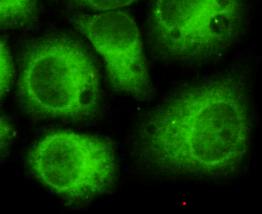
Immunocytochemistry of HeLa cells using anti- CDK5(N-terminus) antibody diluted 1:150.
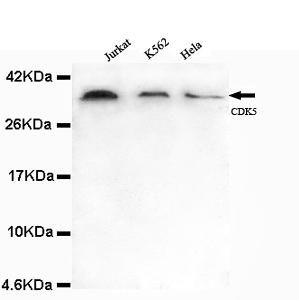
Western blot detection of CDK5(N-terminus) antibody in Jurkat,K562&Hela lysates using CDK5(N-terminus) antibody (1:1000 diluted). Predicted band size: 36KDa Observed band size: 36KDa.
Conjugated Antibody
This product is also available conjugated. Format: E2200543-Conjugate. Price: $485 / Size: 100μl.
E2200543-FITC$485 / 100μlE2200543-Biotin$485 / 100μlE2200543-HRP$485 / 100μlE2200543-AP$485 / 100μlE2200543-AF350$485 / 100μlE2200543-AF405M$485 / 100μlE2200543-AF488$485 / 100μlE2200543-AF514$485 / 100μlE2200543-AF532$485 / 100μlE2200543-AF555$485 / 100μlE2200543-AF568$485 / 100μlE2200543-AF405S$485 / 100μlE2200543-AF405L$485 / 100μlE2200543-AF546$485 / 100μlE2200543-AF594$485 / 100μlE2200543-AF610$485 / 100μlE2200543-AF635$485 / 100μlE2200543-AF647$485 / 100μlE2200543-AF680$485 / 100μlE2200543-AF700$485 / 100μlE2200543-AF750$485 / 100μlE2200543-AF790$485 / 100μlE2200543-APC$485 / 100μlE2200543-PE$485 / 100μlE2200543-Cy3$485 / 100μlE2200543-Cy5$485 / 100μlE2200543-Cy5.5$485 / 100μlE2200543-Cy7$485 / 100μlE2200543-PE-Cy5$485 / 100μl
Contact order@enogene.com to order conjugated formats. Magnetic Beads (1-30μm) conjugation is also available.


Categories by research area
Categories by product type
- Antibodies
- Primary Antibodies
- Tag antibodies
- Internal control antibodies
- Pathological (Immunohistochemistry, IHC) antibodies
- Cell Signal Transduction Research Antibodies
- Secondary Antibody
- Antibody Sampler Kits
- ELISA Kits
- Recombinant Proteins
- Fluorescence Reagents
- Signal Inhibitors and Activators
- Transfection Reagent
- Cell biology kits
- Overexpression Cell Lines
- Cell Lysates
- Purification Resins
- 2019-nCoV & Monkeypox