World supplier of antibodies, antigens and kits since 2007

Primary Antibodies
Hsp70 1A (2D4) Mouse mAb
$255/ 100ul
QuantityTotal: $255
Ship worldwide. Contact order@enogene.com for ordering and bulk pricing or contact your local distributor.
Form Or Antibody
Form of AntibodyLiquid in PBS containing 50% glycerol, 0.5% BSA and 0.02% sodium azide, pH 7.3.
Specificty Sensitivity
Specificity/SensitivityThis antibody detects endogenous levels Hsp70(N-terminus) and does not cross-react with related proteins.
Product Information
Entrez summaryThis intronless gene encodes a 70kDa heat shock protein which is a member of the heat shock protein 70 family. In conjuction with other heat shock proteins, this protein stabilizes existing proteins against aggregation and mediates the folding of newly translated proteins in the cytosol and in organelles. It is also involved in the ubiquitin-proteasome pathway through interaction with the AU-rich element RNA-binding protein 1. The gene is located in the major histocompatibility complex class III region, in a cluster with two closely related genes which encode similar proteins.
UniPort summary FunctionIn cooperation with other chaperones, Hsp70s stabilize preexistent proteins against aggregation and mediate the folding of newly translated polypeptides in the cytosol as well as within organelles. These chaperones participate in all these processes through their ability to recognize nonnative conformations of other proteins. They bind extended peptide segments with a net hydrophobic character exposed by polypeptides during translation and membrane translocation, or following stress-induced damage. In case of rotavirus A infection, serves as a post-attachment receptor for the virus to facilitate entry into the cell
IsotypeIgG1
Molecular WeightCalculated MW: 70 kDa; Observed MW: 70 kDa
UniProt NumberP08107
Gene symbolHSP72; HSPA1; HSP70I; HSPA1B; HSP70-1; HSP70-1A
Product TypePrimary Antibody
Clone Number2D4-F7-C11
Recommended DilutionsWB: 1/500-1/1000 IF: 1/50-1/200
ImmunogenPurified recombinant human Hsp70(N-terminus) protein fragments expressed in E.coli.
Antibody typeMonoclonal Antibody
PurificationAffinity Purified
Cellular localizationCytoplasm
Gene ID3303
All Names
AlternameHSP72; HSPA1; HSP70I; HSPA1B; HSP70-1; HSP70-1A.
Price255$
Research AreaAutophagy antibody Cancer Cardiovascular Cell Biology Epigenetics & Nuclear Signaling Developmental Biologys Immunology Drug Discovery Products Metabolism Neuroscience Signal Transduction Stem Cells
BackgroundIn conjuction with other heat shock proteins, this protein stabilizes existing proteins against aggregation and mediates the folding of newly translated proteins in the cytosol and in organelles. It is also involved in the ubiquitin-proteasome pathway through interaction with the AU-rich element RNA-binding protein 1. The gene is located in the major histocompatibility complex class III region, in a cluster with two closely related genes which encode similar proteins.
Gene NameHSPA1A
Storage/StabilityStore at 4°C short term. Aliquot and store at -20°C long term. Avoid freeze/thaw cycles.
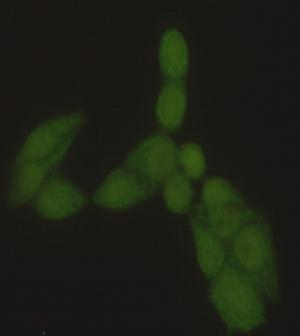
Immunocytochemistry stain of Hela using HSPA1A antibody (1:300).
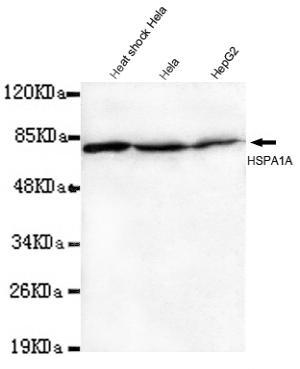
Western blot detection of Hsp70(N-terminus) antibody in Heat shcok Hela,Hela&HepG2 lysates using Hsp70(N-terminus) antibody (1:1000 diluted). Predicted band size: 70KDa Observed band size: 70KDa.
Conjugated Antibody
This product is also available conjugated. Format: E2200303-Conjugate. Price: $485 / Size: 100μl.
E2200303-FITC$485 / 100μlE2200303-Biotin$485 / 100μlE2200303-HRP$485 / 100μlE2200303-AP$485 / 100μlE2200303-AF350$485 / 100μlE2200303-AF405M$485 / 100μlE2200303-AF488$485 / 100μlE2200303-AF514$485 / 100μlE2200303-AF532$485 / 100μlE2200303-AF555$485 / 100μlE2200303-AF568$485 / 100μlE2200303-AF405S$485 / 100μlE2200303-AF405L$485 / 100μlE2200303-AF546$485 / 100μlE2200303-AF594$485 / 100μlE2200303-AF610$485 / 100μlE2200303-AF635$485 / 100μlE2200303-AF647$485 / 100μlE2200303-AF680$485 / 100μlE2200303-AF700$485 / 100μlE2200303-AF750$485 / 100μlE2200303-AF790$485 / 100μlE2200303-APC$485 / 100μlE2200303-PE$485 / 100μlE2200303-Cy3$485 / 100μlE2200303-Cy5$485 / 100μlE2200303-Cy5.5$485 / 100μlE2200303-Cy7$485 / 100μlE2200303-PE-Cy5$485 / 100μl
Contact order@enogene.com to order conjugated formats. Magnetic Beads (1-30μm) conjugation is also available.


Categories by research area
Categories by product type
- Antibodies
- Primary Antibodies
- Tag antibodies
- Internal control antibodies
- Pathological (Immunohistochemistry, IHC) antibodies
- Cell Signal Transduction Research Antibodies
- Secondary Antibody
- Antibody Sampler Kits
- ELISA Kits
- Recombinant Proteins
- Fluorescence Reagents
- Signal Inhibitors and Activators
- Transfection Reagent
- Cell biology kits
- Overexpression Cell Lines
- Cell Lysates
- Purification Resins
- 2019-nCoV & Monkeypox