World supplier of antibodies, antigens and kits since 2007

Primary Antibodies
CD227/Mucin 1 (Phospho-Tyr1243) Antibody
$225/ 100μg
QuantityTotal: $225
Ship worldwide. Contact order@enogene.com for ordering and bulk pricing or contact your local distributor.
Other Names Breast carcinoma-associated antigen DF3, CD227, Carcinoma-associated mucin, EMA, Episialin, H23AG, MUC-1, MUC1, Mucin 1 precursor, PEM, PEMT, PUM, Peanut-reactive urinary mucin, Polymorphic epithelial mucin, Tumor-associated epithelial membrane antigen, Tumor-associated mucin
All Sites Human: Tyr1243; Mouse: Tyr618
Storage/Stability Store at -20℃/1 year
Form Or Antibody
Form of Antibody Rabbit IgG in phosphate buffered saline (without Mg2+ and Ca2+), pH 7.4, 150mM NaCl, 0.02% sodium azide and 50% glycerol.
Immunogen The antiserum was produced against synthesized phosphopeptide derived from human CD227/Mucin 1 around the phosphorylation site oftyrosine 1243 (L-S-YP-T-N).
Purification The antibody was affinity-purified from rabbit antiserum by affinity-chromatography using epitope-specific phosphopeptide. The antibody against non-phosphopeptide was removed by chromatography using non-phosphopeptide corresponding to the phosphorylation site.
Specificty Sensitivity
Specificity/Sensitivity CD227/Mucin 1 (Phospho-Tyr1243) antibody detects endogenous levels of CD227/Mucin 1 only when phosphorylated at tyrosine 1243.
ReferencesLan M.S., J. Biol. Chem. 265:15294-15299(1990).
Weiss M., Int. J. Cancer 66:55-59(1996).
Yu C.J., Oncology 53:118-126(1996).
Weiss M., Int. J. Cancer 66:55-59(1996).
Yu C.J., Oncology 53:118-126(1996).
Price225$
Research AreaAutophagy antibody Cancer Cardiovascular Cell Biology Epigenetics & Nuclear Signaling Developmental Biologys Immunology Drug Discovery Products Metabolism Neuroscience Signal Transduction Stem Cells
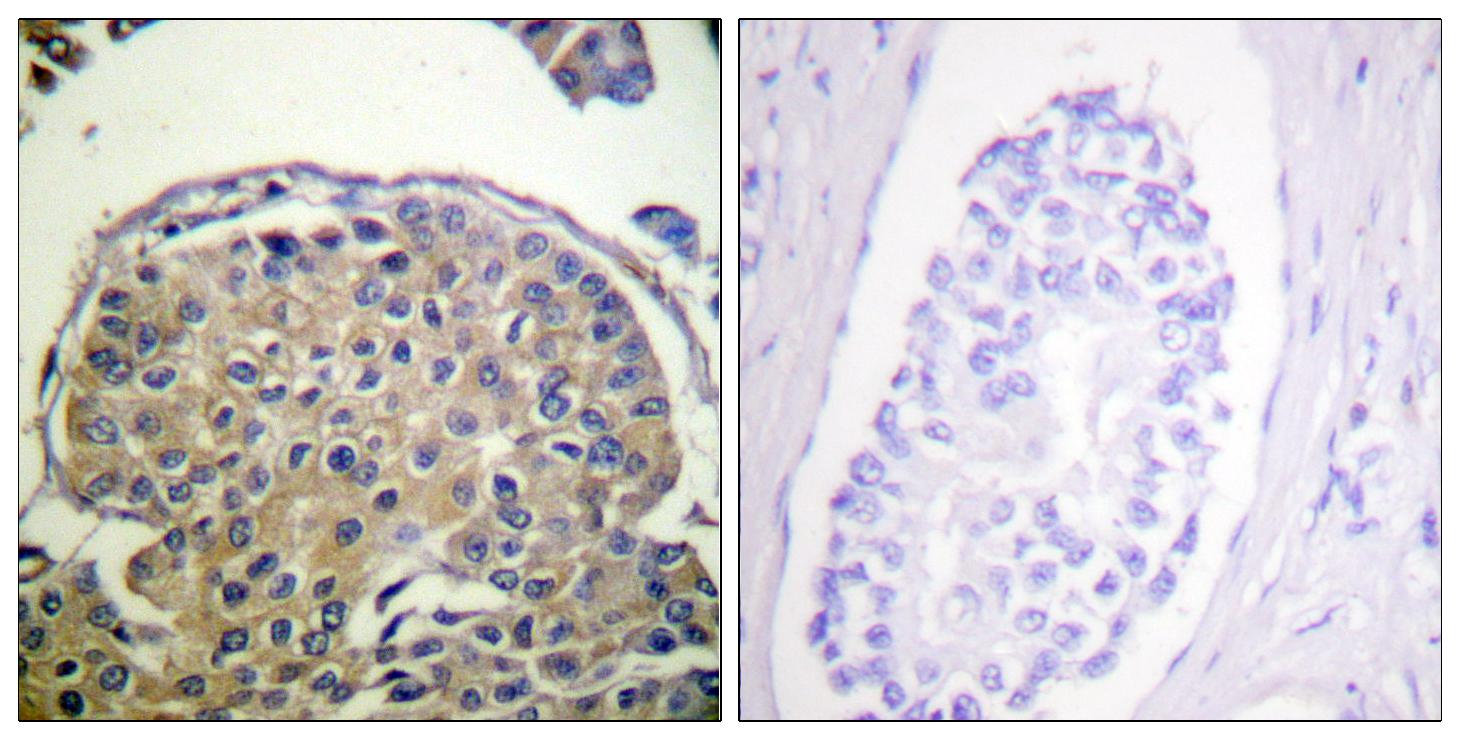
Immunohistochemistry analysis of paraffin-embedded human breast carcinoma tissue using CD227/Mucin 1 (Phospho-Tyr1243) antibody.
Conjugated Antibody
This product is also available conjugated. Format: E11-0844A-Conjugate. Price: $485 / Size: 100μl.
E11-0844A-FITC$485 / 100μlE11-0844A-Biotin$485 / 100μlE11-0844A-HRP$485 / 100μlE11-0844A-AP$485 / 100μlE11-0844A-AF350$485 / 100μlE11-0844A-AF405M$485 / 100μlE11-0844A-AF488$485 / 100μlE11-0844A-AF514$485 / 100μlE11-0844A-AF532$485 / 100μlE11-0844A-AF555$485 / 100μlE11-0844A-AF568$485 / 100μlE11-0844A-AF405S$485 / 100μlE11-0844A-AF405L$485 / 100μlE11-0844A-AF546$485 / 100μlE11-0844A-AF594$485 / 100μlE11-0844A-AF610$485 / 100μlE11-0844A-AF635$485 / 100μlE11-0844A-AF647$485 / 100μlE11-0844A-AF680$485 / 100μlE11-0844A-AF700$485 / 100μlE11-0844A-AF750$485 / 100μlE11-0844A-AF790$485 / 100μlE11-0844A-APC$485 / 100μlE11-0844A-PE$485 / 100μlE11-0844A-Cy3$485 / 100μlE11-0844A-Cy5$485 / 100μlE11-0844A-Cy5.5$485 / 100μlE11-0844A-Cy7$485 / 100μlE11-0844A-PE-Cy5$485 / 100μl
Contact order@enogene.com to order conjugated formats. Magnetic Beads (1-30μm) conjugation is also available.


Categories by research area
Categories by product type
- Antibodies
- Primary Antibodies
- Tag antibodies
- Internal control antibodies
- Pathological (Immunohistochemistry, IHC) antibodies
- Cell Signal Transduction Research Antibodies
- Secondary Antibody
- Antibody Sampler Kits
- ELISA Kits
- Recombinant Proteins
- Fluorescence Reagents
- Signal Inhibitors and Activators
- Transfection Reagent
- Cell biology kits
- Overexpression Cell Lines
- Cell Lysates
- Purification Resins
- 2019-nCoV & Monkeypox