World supplier of antibodies, antigens and kits since 2007

Primary Antibodies
NAC1 Antibody
Human
WB, IHC, ELISA. Not yet tested in other applications.
$225/ 100μg/100μl
QuantityTotal: $225
Ship worldwide. Contact order@enogene.com for ordering and bulk pricing or contact your local distributor.
BackgroundNAC1 or nuclear accumbens-1 is a nuclear factor that belongs to the POZ/BTB (Pox virus and zinc finger/bric-a-brac tramtrack broad complex) domain family. Also known as BTBD14B, it was originally identified in a unique neuronal forebrain structure responsible for reward motivation and addictive behaviors . NAC1 recruits HDAC3 and HDAC4 to transcriptionally repress gene expression in neuronal cells (3) and specifically co-represses other POZ/BTB proteins in the central nervous system . NAC1 is upregulated in several tumor types, including breast, renal cell, and hepatocellular carcinoma, as well as high grade ovarian serous carcinoma, where it has long been suspected as a chemoresistance gene . The chemoresistance mechanism reportedly occurs through NAC1 negative regulation of the GADD45 pathway . NAC1 has also been described as part of the extended transcriptional network in pluripotent cells that involves Oct-4, Sox2, Nanog, Sall1, KLF4 and Sall4 . Tissue specificity:
Product Information
Clone Number6H2
SpeciesMouse IgG1
Entrez Gene112939
Recommended DilutionsWB: 1/500 - 1/2000, IHC: 1/200 - 1/1000, ELISA: Propose dilution 1/10000.
Molecular Weight58kDa
All Names
AlternameNAC1; BEND8; NAC-1; BTBD14B; FLJ37383; NACC1
ImmunogenPurified recombinant fragment of human NACC1 expressed in E. Coli.
Storage/StabilityStore at 4℃, for long term storage, store at -20℃.
Form Or Antibody
Form of AntibodyAscitic fluid containing 0.03% sodium azide.
Price225$
Research AreaAutophagy antibody Cancer Cardiovascular Cell Biology Epigenetics & Nuclear Signaling Developmental Biologys Immunology Drug Discovery Products Metabolism Neuroscience Signal Transduction Stem Cells

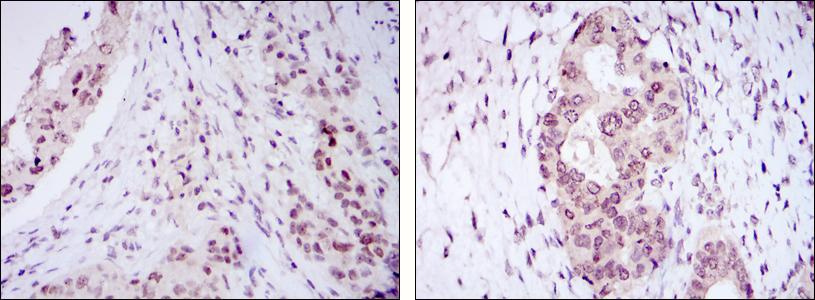
Figure 1: Western blot analysis using NACC1 mAb against HEK293 (1) and NACC1-hIgGFc transfected HEK293 (2) cell lysate.
Conjugated Antibody
This product is also available conjugated. Format: E10-30137-Conjugate. Price: $485 / Size: 100μl.
E10-30137-FITC$485 / 100μlE10-30137-Biotin$485 / 100μlE10-30137-HRP$485 / 100μlE10-30137-AP$485 / 100μlE10-30137-AF350$485 / 100μlE10-30137-AF405M$485 / 100μlE10-30137-AF488$485 / 100μlE10-30137-AF514$485 / 100μlE10-30137-AF532$485 / 100μlE10-30137-AF555$485 / 100μlE10-30137-AF568$485 / 100μlE10-30137-AF405S$485 / 100μlE10-30137-AF405L$485 / 100μlE10-30137-AF546$485 / 100μlE10-30137-AF594$485 / 100μlE10-30137-AF610$485 / 100μlE10-30137-AF635$485 / 100μlE10-30137-AF647$485 / 100μlE10-30137-AF680$485 / 100μlE10-30137-AF700$485 / 100μlE10-30137-AF750$485 / 100μlE10-30137-AF790$485 / 100μlE10-30137-APC$485 / 100μlE10-30137-PE$485 / 100μlE10-30137-Cy3$485 / 100μlE10-30137-Cy5$485 / 100μlE10-30137-Cy5.5$485 / 100μlE10-30137-Cy7$485 / 100μlE10-30137-PE-Cy5$485 / 100μl
Contact order@enogene.com to order conjugated formats. Magnetic Beads (1-30μm) conjugation is also available.


Categories by research area
Categories by product type
- Antibodies
- Primary Antibodies
- Tag antibodies
- Internal control antibodies
- Pathological (Immunohistochemistry, IHC) antibodies
- Cell Signal Transduction Research Antibodies
- Secondary Antibody
- Antibody Sampler Kits
- ELISA Kits
- Recombinant Proteins
- Fluorescence Reagents
- Signal Inhibitors and Activators
- Transfection Reagent
- Cell biology kits
- Overexpression Cell Lines
- Cell Lysates
- Purification Resins
- 2019-nCoV & Monkeypox