World supplier of antibodies, antigens and kits since 2007

Primary Antibodies
HAS1 Antibody
Human
WB, IHC, ELISA. Not yet tested in other applications.
$225/ 100μg/100μl
QuantityTotal: $225
Ship worldwide. Contact order@enogene.com for ordering and bulk pricing or contact your local distributor.
BackgroundHyaluronan or hyaluronic acid (HA) is a high molecular weight unbranched polysaccharide synthesized by a wide variety of organisms from bacteria to mammals, and is a constituent of the extracellular matrix. It consists of alternating glucuronic acid and N-acetylglucosamine residues that are linked by beta-1-3 and beta-1-4 glycosidic bonds. HA is synthesized by membrane-bound synthase at the inner surface of the plasma membrane, and the chains are extruded through pore-like structures into the extracellular space. It serves a variety of functions, including space filling, lubrication of joints, and provision of a matrix through which cells can migrate. HA is actively produced during wound healing and tissue repair to provide a framework for ingrowth of blood vessels and fibroblasts. Changes in the serum concentration of HA are associated with inflammatory and degenerative arthropathies such as rheumatoid arthritis. In addition, the interaction of HA with the leukocyte receptor CD44 is important in tissue-specific homing by leukocytes, and overexpression of HA receptors has been correlated with tumor metastasis.
Product Information
Clone Number3E10
SpeciesMouse IgG1
Entrez Gene3036
Recommended DilutionsWB: 1/500 - 1/2000, IHC: 1/200-1/1000, ELISA: Propose dilution 1/10000.
Molecular Weight65kDa
All Names
AlternameHAS; HAS1
ImmunogenPurified recombinant fragment of human HAS1 expressed in E. Coli.
Storage/StabilityStore at 4℃, for long term storage, store at -20℃.
Form Or Antibody
Form of AntibodyAscitic fluid containing 0.03% sodium azide.
Price225$
Research AreaAutophagy antibody Cancer Cardiovascular Cell Biology Epigenetics & Nuclear Signaling Developmental Biologys Immunology Drug Discovery Products Metabolism Neuroscience Signal Transduction Stem Cells

Figure 1: Western blot analysis using HAS1 mouse mAb against recombinant protein of human HAS1 (aa70-243).
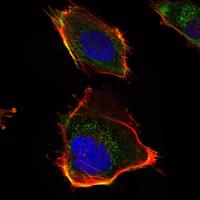
Figure 2: Immunofluorescence analysis of U251 cells using HAS1 mAb (green). Red: Actin filaments have been labeled with DY-554 phalloidin. Blue: DRAQ5 fluorescent DNA dye.
Conjugated Antibody
This product is also available conjugated. Format: E10-30080-Conjugate. Price: $485 / Size: 100μl.
E10-30080-FITC$485 / 100μlE10-30080-Biotin$485 / 100μlE10-30080-HRP$485 / 100μlE10-30080-AP$485 / 100μlE10-30080-AF350$485 / 100μlE10-30080-AF405M$485 / 100μlE10-30080-AF488$485 / 100μlE10-30080-AF514$485 / 100μlE10-30080-AF532$485 / 100μlE10-30080-AF555$485 / 100μlE10-30080-AF568$485 / 100μlE10-30080-AF405S$485 / 100μlE10-30080-AF405L$485 / 100μlE10-30080-AF546$485 / 100μlE10-30080-AF594$485 / 100μlE10-30080-AF610$485 / 100μlE10-30080-AF635$485 / 100μlE10-30080-AF647$485 / 100μlE10-30080-AF680$485 / 100μlE10-30080-AF700$485 / 100μlE10-30080-AF750$485 / 100μlE10-30080-AF790$485 / 100μlE10-30080-APC$485 / 100μlE10-30080-PE$485 / 100μlE10-30080-Cy3$485 / 100μlE10-30080-Cy5$485 / 100μlE10-30080-Cy5.5$485 / 100μlE10-30080-Cy7$485 / 100μlE10-30080-PE-Cy5$485 / 100μl
Contact order@enogene.com to order conjugated formats. Magnetic Beads (1-30μm) conjugation is also available.


Categories by research area
Categories by product type
- Antibodies
- Primary Antibodies
- Tag antibodies
- Internal control antibodies
- Pathological (Immunohistochemistry, IHC) antibodies
- Cell Signal Transduction Research Antibodies
- Secondary Antibody
- Antibody Sampler Kits
- ELISA Kits
- Recombinant Proteins
- Fluorescence Reagents
- Signal Inhibitors and Activators
- Transfection Reagent
- Cell biology kits
- Overexpression Cell Lines
- Cell Lysates
- Purification Resins
- 2019-nCoV & Monkeypox