World supplier of antibodies, antigens and kits since 2007

Primary Antibodies
Stathmin 1 (Ab-37) Antibody
Human, Mouse, Rat
WB: 1:500~1:1000 IHC: 1:50~1:100
Integrin β3 (Ab-773) Antibody
E021082-1
50μg/50μl
IHC, WB
Human, Mouse
Rabbit
Paxillin (Ab-31) Antibody
E021199-1
50μg/50μl
IHC, WB
Human
Rabbit
FAK(Ab-861) Antibody
E021076-1
50μg/50μl
WB
Human, Mouse, Rat
Rabbit
Src (Ab-418) Antibody
E021115-1
50μg/50μl
WB
Human, Mouse, Rat
Rabbit
Stathmin 1 (Ab-37) Antibody
E021218-1
50μg/50μl
IHC, WB
Human, Mouse, Rat
Rabbit
Integrins are integral cell-surface proteins composed of an alpha chain and a beta chain. A given chain may combine with multiple partners resulting in different integrins. Integrin beta 3 is found along with the alpha IIb chain in platelets. Integrins are known to participate in cell adhesion as well as cell-surface mediated signalling. Integrin alpha-V/beta-3 is a receptor for cytotactin, fibronectin, laminin, matrix metalloproteinase-2, osteopontin, osteomodulin, prothrombin, thrombospondin, vitronectin and von Willebrand factor. Integrin alpha-IIb/beta-3 is a receptor for fibronectin, fibrinogen, plasminogen, prothrombin, thrombospondin and vitronectin. Integrins alpha-IIb/beta-3 and alpha-V/beta-3 recognize the sequence R-G-D in a wide array of ligands. Integrin alpha-IIb/beta-3 recognizes the sequence H-H-L-G-G-G-A-K-Q-A-G-D-V in fibrinogen gamma chain. Following activation integrin alpha-IIb/beta-3 brings about platelet/platelet interaction through binding of soluble fibrinogen. This step leads to rapid platelet aggregation which physically plugs ruptured endothelial surface. In case of HIV-1 infection, the interaction with extracellular viral Tat protein seems to enhance angiogenesis in Kaposi's sarcoma lesions.
Integrins are ubiquitously expressed adhesion molecules. They are cell-surface receptors that exist as heterodimers of alpha and beta subunits. At physiological conditions, integrins are highly glycosylated and contain a Ca2+ or Mg2+ ion, which is essential for ligand binding. Integrin receptors are critical for cell attachment to the extracellular matrix (ECM) and this is mediated through integrin-fibronectin, -vitronectin, -collagen and -laminin interactions. Intracellularly, integrins form adhesion complexes with proteins including talin, vinculin, paxillin and alpha-actinin. They also regulate kinases, such as focal adhesion kinase and Src family kinases, to mediate attachment to the actin cytoskeleton. Integrins also have a significant role in cell signaling and can activate protein kinases involved in the regulation of cell growth, division, survival, differentiation, migration and apoptosis. Glycoprotein II/IIIb (alphaIIbbeta3) is an integrin receptor found on the surface of platelets. It is involved in the cross-linking of platelets with fibrin, and so has a vital role in blood clot formation. Cytoskeletal protein involved in actin-membrane attachment at sites of cell adhesion to the extracellular matrix (focal adhesion). Phosphorylated on tyrosine residues during integrin-mediated cell adhesion, embryonic development, fibroblast transformation and following stimulation of cells by mitogens.
PTK2 gene encodes a cytoplasmic protein tyrosine kinase which is found concentrated in the focal adhesions that form between cells growing in the presence of extracellular matrix constituents. The encoded protein is a member of the FAK subfamily of protein tyrosine kinases but lacks significant sequence similarity to kinases from other subfamilies. Activation of this gene may be an important early step in cell growth and intracellular signal transduction pathways triggered in response to certain neural peptides or to cell interactions with the extracellular matrix. At least four transcript variants encoding four different isoforms have been found for this gene, but the full-length natures of only two of them have been determined. Non-receptor protein-tyrosine kinase implicated in signaling pathways involved in cell motility, proliferation and apoptosis. Activated by tyrosine-phosphorylation in response to either integrin clustering induced by cell adhesion or antibody cross-linking, or via G-protein coupled receptor (GPCR) occupancy by ligands such as bombesin or lysophosphatidic acid, or via LDL receptor occupancy. Plays a potential role in oncogenic transformations resulting in increased kinase activity.
Focal adhesion kinase (FAK), a non-receptor tyrosine kinase, is the first intracellular step in the signal transduction cascade initiated by the attachment of an integrin to the extracellular matrix at points known as focal adhesions. Therefore, FAK is plays a key role in cellular migration and motility. FAK has 3 functional domains: a focal adhesion targeting domain (FAT), a catalytic domain and a FERM domain, which mediates interactions with the cytoplasmic domains of integrins and growth factor receptors. FAK has multiple phosphorylation sites that are required for binding to adaptor proteins containing SH2 domains (e.g. Src and SH3 domains (e.g. CAS, GRAF)). Key amongst these phosphorylation sites is Tyr397, which is important for t
$100/ 50μg/50μl
Specification
QuantityTotal: $100
Ship worldwide. Contact order@enogene.com for ordering and bulk pricing or contact your local distributor.
Form Or Antibody
Form of AntibodyRabbit IgG in phosphate buffered saline (without Mg2+ and Ca2+), pH 7.4, 150mM NaCl, 0.02% sodium azide and 50% glycerol.
Storage/StabilityStore at -20℃/1 year
ImmunogenThe antiserum was produced against synthesized non-phosphopeptide derived from human Stathmin 1 around the phosphorylation site of serine 37 (P-L-SP-P-P).
PurificationThe antibody was affinity-purified from rabbit antiserum by affinity-chromatography using epitope-specific immunogen.
Specificty Sensitivity
Specificity/SensitivityStathmin 1 (Ab-37) antibody detects endogenous levels of total Stathmin 1 protein.
ReferencesWang KK, et al. (1991) Biochem J 279(Pt 2): 537-544.
Sekimoto T, et al. (2004) EMBO J 23(9): 1934-1942.
Doye V, et al. (1992) Biochem J 287(Pt 2): 549-554.
Larsson N, et al. (1999) Mol Cell Biol 19(3): 2242-2250.
Sekimoto T, et al. (2004) EMBO J 23(9): 1934-1942.
Doye V, et al. (1992) Biochem J 287(Pt 2): 549-554.
Larsson N, et al. (1999) Mol Cell Biol 19(3): 2242-2250.
Price100$
All Names
AlternamePAX-1, PXN, Paired box protein Pax-1, paxillin, paxillin alpha
All SitesHuman: Tyr31
Research AreaAutophagy antibody Cancer Cardiovascular Cell Biology Epigenetics & Nuclear Signaling Developmental Biologys Immunology Drug Discovery Products Metabolism Neuroscience Signal Transduction Stem Cells

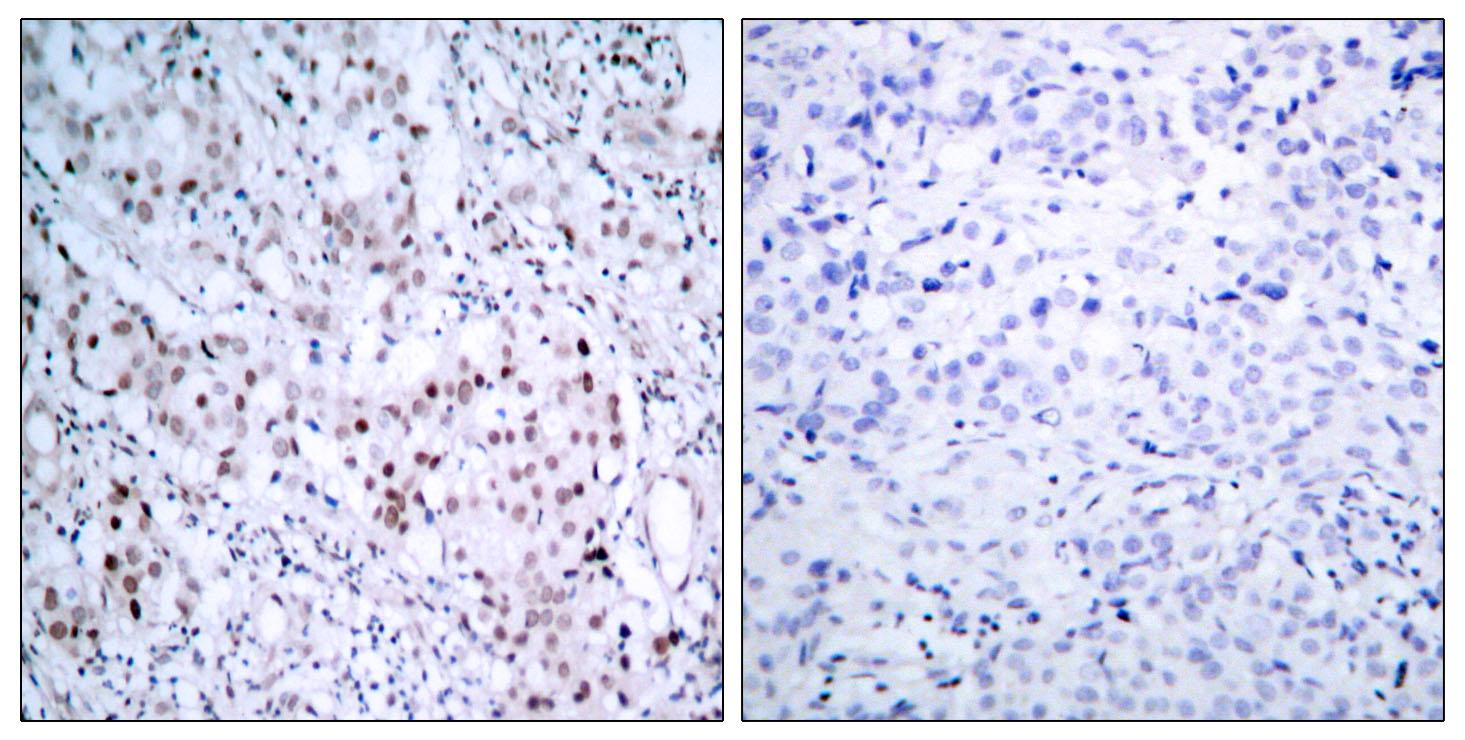
Immunohistochemical analysis of paraffin-embedded human breast carcinoma tissue using Stathmin 1 (Ab-37) antibody (E021218).
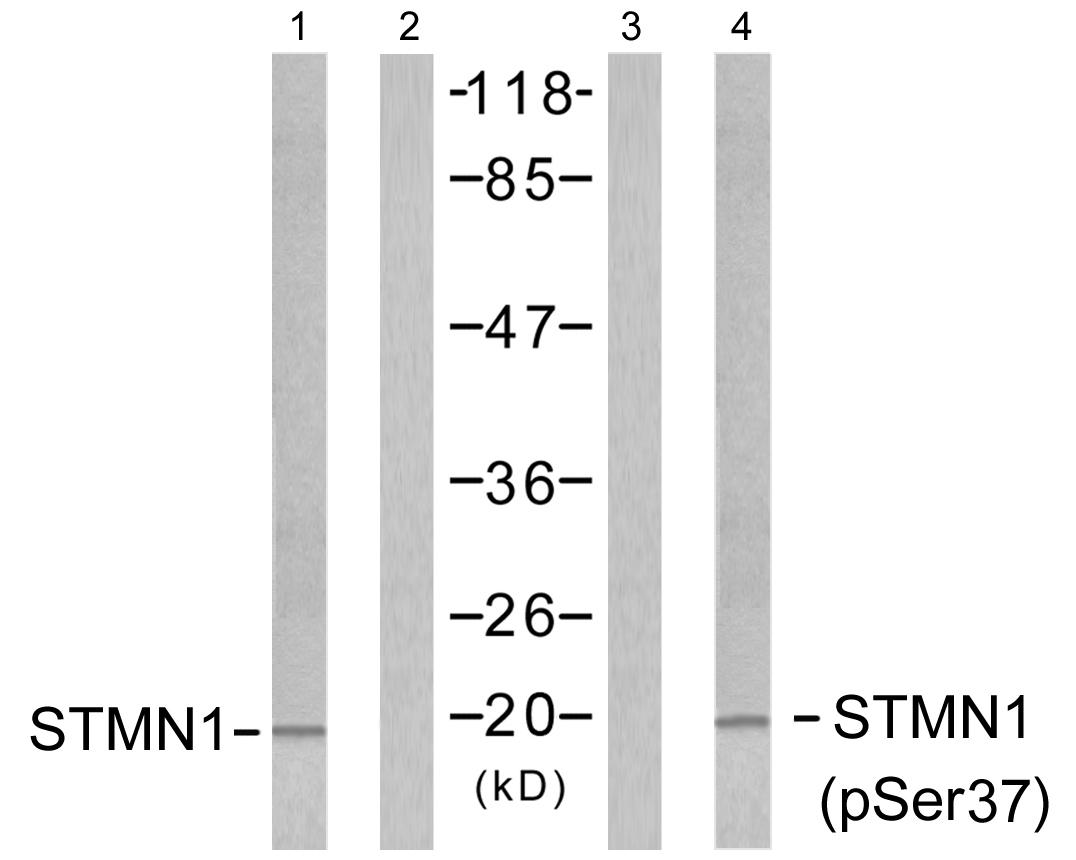
Western blot analysis of extracts from Jurkat cells untreated or treated with PMA (1ng/ml, 15min), using Stathmin 1 (Ab-37) antibody (E021218, Line 1 and 2) and Stathmin 1 (phospho-Ser37) antibody (E011225, Line 3 and 4).
Conjugated Antibody
This product is also available conjugated. Format: E021218-1-Conjugate. Price: $485 / Size: 100μl.
E021218-1-FITC$485 / 100μlE021218-1-Biotin$485 / 100μlE021218-1-HRP$485 / 100μlE021218-1-AP$485 / 100μlE021218-1-AF350$485 / 100μlE021218-1-AF405M$485 / 100μlE021218-1-AF488$485 / 100μlE021218-1-AF514$485 / 100μlE021218-1-AF532$485 / 100μlE021218-1-AF555$485 / 100μlE021218-1-AF568$485 / 100μlE021218-1-AF405S$485 / 100μlE021218-1-AF405L$485 / 100μlE021218-1-AF546$485 / 100μlE021218-1-AF594$485 / 100μlE021218-1-AF610$485 / 100μlE021218-1-AF635$485 / 100μlE021218-1-AF647$485 / 100μlE021218-1-AF680$485 / 100μlE021218-1-AF700$485 / 100μlE021218-1-AF750$485 / 100μlE021218-1-AF790$485 / 100μlE021218-1-APC$485 / 100μlE021218-1-PE$485 / 100μlE021218-1-Cy3$485 / 100μlE021218-1-Cy5$485 / 100μlE021218-1-Cy5.5$485 / 100μlE021218-1-Cy7$485 / 100μlE021218-1-PE-Cy5$485 / 100μl
Contact order@enogene.com to order conjugated formats. Magnetic Beads (1-30μm) conjugation is also available.


Categories by research area
Categories by product type
- Antibodies
- Primary Antibodies
- Tag antibodies
- Internal control antibodies
- Pathological (Immunohistochemistry, IHC) antibodies
- Cell Signal Transduction Research Antibodies
- Secondary Antibody
- Antibody Sampler Kits
- ELISA Kits
- Recombinant Proteins
- Fluorescence Reagents
- Signal Inhibitors and Activators
- Transfection Reagent
- Cell biology kits
- Overexpression Cell Lines
- Cell Lysates
- Purification Resins
- 2019-nCoV & Monkeypox