World supplier of antibodies, antigens and kits since 2007

Other Products
Recombinant Human Fibronectin Protein (Tag free)
E. coli
$225/ 100ug
QuantityTotal: $225
Ship worldwide. Contact order@enogene.com for ordering and bulk pricing or contact your local distributor.
Product Information
Cite ID#EN5597104
Expression systemfFN,produced in E.coli is a single non-glycosylated polypeptide chain containing 574 amino acids. A fully biologically active molecule has a molecular mass of 62.6 kDa. The apparent molecular mass of the protein is approximately 63 kDa analyzed by reducing SDS-PAGE and is obtained by chromatographic techniques.
SpeciesHuman
Amino acid sequenceMPTDLRFTNIGPDTMRVTWAPPPSIDLTNFLVRYSPVKNEEDVAELSISPSDNAVVLTNLLPGTEYVVSVSSVYEQHESTPLRGRQKTGLDSPTGIDFSDITANSFTVHWIAPRATITGYRIRHHPEHFSGRPREDRVPHSRNSITLTNLTPGTEYVVSIVALNGREESPLLIGQQSTVSDVPRDLEVVAATPTSLLISWDAPAVTVRYYRITYGETGGNSPVQEFTVPGSKSTATISGLKPGVDYTITVYAVTGRGDSPASSKPISINYRTEIDKPSAIPAPTDLKFTQVTPTSLSAQWTPPNVQLTGYRVRVTPKEKTGPMKEINLAPDSSSVVVSGLMVATKYEVSVYALKDTLTSRPAQGVVTTLENVSPPRRARVTDATETTITISWRTKTETITGFQVDAVPANGQTPIQRTIKPDVRSYTITGLQPGTDYKIYLYTLNDNARSSPVVIDASTAIDAPSNLRFLATTPNSLLVSWQPPRARITGYIIKYEKPGSPPREVVPRPRPGVTEATITGLEPGTEYTIYVIALKNNQKSEPLIGRKKTDELPQLVTLPHPNLHGPEILDVPSTAccession #: P02751
Molecular Weight62.6kDa. The apparent molecular mass of the protein is approximately 63kDa observed by reducing SDS-PAGE.
Purity> 90% as analyzed by SDS-PAGE. The concentration is 0.87mg/ml.
FormulationPurified protein solution after extensive dialysis against 20mM Tris,150mM NaCl,pH 8.0.
EndotoxinLess than 0.2 EU/μg determined by LAL test.
Samples are stable for up to twelve months from date of receipt at -20℃ to -80℃. It is recommended that the protein be aliquoted for optimal storage. Avoid repeated freeze-thaw cycles.
Other NamesFibronectin; FN; Cold-insoluble globulin; CIG; fFN; Fibronectin 1
BackgroundFibronectin1(FN1) is a secreted protein and contains 12 fibronectin type-I domains, fibronectin type-II domains and 16 fibronectin type-III domains. Recombinant human fibronectin fragment, is a protein of ~63 kDa containing a central cell-binding domain, a high affinity heparin-binding domain II,and CS1 site within the alternatively spliced III CS region of human fibronectin. Cells bind to a VLA-4 ligand, a CS-I site, and a VLA-5 ligand, a cell attachment domain, and virus vectors binds to a heparin binding domain II, which co-locates the cell and the virus vector on NovoNectin. This process enhances the density of both cells and vectors, and facilitates the gene transduction in the result.
Price225$
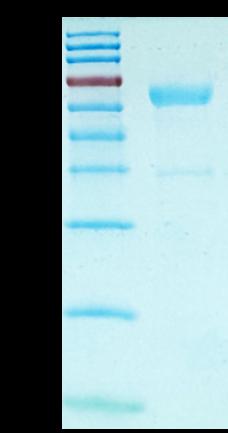
SDS-PAGE of Fibronectin (Cat#:EGPS051D).
Conjugated Antibody
This product is also available conjugated. Format: EGPS051D-100-Conjugate. Price: $485 / Size: 100μl.
EGPS051D-100-FITC$485 / 100μlEGPS051D-100-Biotin$485 / 100μlEGPS051D-100-HRP$485 / 100μlEGPS051D-100-AP$485 / 100μlEGPS051D-100-AF350$485 / 100μlEGPS051D-100-AF405M$485 / 100μlEGPS051D-100-AF488$485 / 100μlEGPS051D-100-AF514$485 / 100μlEGPS051D-100-AF532$485 / 100μlEGPS051D-100-AF555$485 / 100μlEGPS051D-100-AF568$485 / 100μlEGPS051D-100-AF405S$485 / 100μlEGPS051D-100-AF405L$485 / 100μlEGPS051D-100-AF546$485 / 100μlEGPS051D-100-AF594$485 / 100μlEGPS051D-100-AF610$485 / 100μlEGPS051D-100-AF635$485 / 100μlEGPS051D-100-AF647$485 / 100μlEGPS051D-100-AF680$485 / 100μlEGPS051D-100-AF700$485 / 100μlEGPS051D-100-AF750$485 / 100μlEGPS051D-100-AF790$485 / 100μlEGPS051D-100-APC$485 / 100μlEGPS051D-100-PE$485 / 100μlEGPS051D-100-Cy3$485 / 100μlEGPS051D-100-Cy5$485 / 100μlEGPS051D-100-Cy5.5$485 / 100μlEGPS051D-100-Cy7$485 / 100μlEGPS051D-100-PE-Cy5$485 / 100μl
Contact order@enogene.com to order conjugated formats. Magnetic Beads (1-30μm) conjugation is also available.


Categories by research area
Categories by product type
- Antibodies
- Primary Antibodies
- Tag antibodies
- Internal control antibodies
- Pathological (Immunohistochemistry, IHC) antibodies
- Cell Signal Transduction Research Antibodies
- Secondary Antibody
- Antibody Sampler Kits
- ELISA Kits
- Recombinant Proteins
- Fluorescence Reagents
- Signal Inhibitors and Activators
- Transfection Reagent
- Cell biology kits
- Overexpression Cell Lines
- Cell Lysates
- Purification Resins
- 2019-nCoV & Monkeypox