World supplier of antibodies, antigens and kits since 2007

2019-nCoV & Monkeypox
SARS-CoV-2 IgM/IgG Test Kit (Immunochromatographic Assay)
$500/ Cassette:50pcs/box
QuantityTotal: $500
Ship worldwide. Contact order@enogene.com for ordering and bulk pricing or contact your local distributor.
Product Information
Samplediluent3dropper【Storage and Expiry date】The shelf life of kit is 12 months when stored sealed and away from light at 4-30°C.Once the inner package is opened and the kit is kept at room temperature (10℃~30℃), please use in 1 hour.Production Date and Expire date please see the label and package.【Apparatus】None【Specimen】This kit can work on whole blood, serum and plasma. The sample can be venous blood or fingertip blood (pinch the puncture site, puncture by a sterile blood needle, then press a dry cotton ball on the wound for a moment).Serum/plasma sample collection: serum and plasma should be separated as soon as possible after collection to avoid hemolysis. The separated serum and plasma should be tested within 8 hours as soon as possible. If they cannot be used in time, they should be stored at 2℃~8℃ for an utmost of 3 days. If storage for more than 3 days is needed, they should be refrigerated at -20℃ for an utmost of 9 days. Before test, restore them to room temperature. Avoid repeated freeze-thaw. Samples with severe hemolysis and thermal inactivation are not recommended to be used.Venous blood collection: collect blood with an anticoagulant tube, or add an anticoagulant (heparin, EDTA salt, sodium citrate are recommended) into the blood vessel, then add the blood sample and shake it well for later use. It can be stored at room temperature for 8 hours. If it cannot be tested immediately, it can be stored at 2~8℃ for 7 days. Venous whole blood samples stored for over 7 days are not suitable for this reagent.【Test Procedure】Take out the cassette and the sample diluent, and restore to room temperature.Open the cassette package, and lay the cassette flat horizontally on the table.Absorb 10 L of sample (serum/plasma/whole blood) and add to the sample well, then immediately add ~100 L (around 2~3 drops) sample diluent.5 minutes later, read the results. Do not read the results after 10 minutes.
Limitationof detection (LOD): the LOD reference S1 shall test negative, and S2 and S3 shall test positiveRepeatability: test 2 repeatability reference materials (J1~J2) for 10 times each, all results should be positive【Warnings and precautions】This product is a disposable in vitro diagnostic regent. Please avoid repeated use. Do not use expired products.Avoid test environment where the temperature is too high. Cassettes and sample diluents stored at a low temperature shall be used after they restore to the room temperature to avoid moisture absorption.The used cassette, sample diluent, droppers and so on shall be regarded as biomedical waste and be properly disposed of.The desiccant in the aluminum foil compound packaging bag should not be taken orally.Do not use repeatedly frozen thawed samples. When testing, please restore the sample temperature to room temperatureThe test samples should be regarded as infectious agents. When conducting tests, please follow the laboratory standards for infectious diseases, and observe biosafety practices.As with all diagnostic reagents, the final diagnosis should be made by the doctors after comprehensively considered all the indicators and clinical symptoms.If you have any question or suggestion about using this reagent, please contact the manufacturer【Label legends】
Price500$
Storage/Stability1.The shelf life of kit is 12 months when stored sealed and away from light at 4-30°C. 2.Once the inner package is opened and the kit is kept at room temperature (10℃~30℃), please use in 1 hour. 3.Production Date and Expire date please see the label and package.
BackgroundThis Immunochromatographic Assay Test Kit contains an IgM antibody test strip and an IgG antibody test strip, each comes with a test line and a control line. When the sample is added to the sample well of the cassette, the sample travels on the strips and separates. When the sample contains SARS-CoV-2 antibodies in concentrations above or equal to the minimum detection limit, the antibodies combine with black microsphere labeled Mouse anti-Human IgM monoclonal antibodies/black microsphere labeled Mouse anti-Human IgG monoclonal antibodies to form immune complexes that are captured by recombinant S protein fixed to the assay line, and the detection line turns black; when the sample does not contain IgM/IgG antibodies, the detection line does not show colour. The control line should be black regardless of the colour of the detection lines. A colourless control line indicates an invalid test result, and the sample needs to be retested.
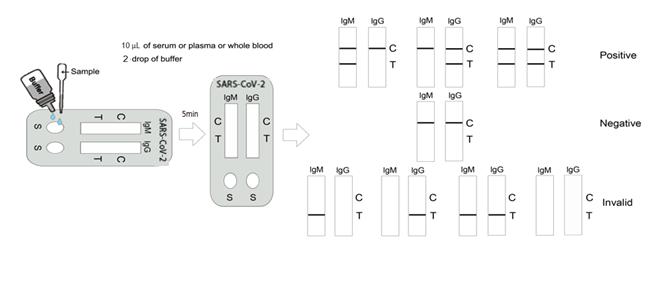
antibody test strip 【Interpretation of the Results】 control line. When 1. Negative: If only control line (C) shows color, while test lines for IgM and IgG travels on the antibody test strips remain colourless, this means no SARS-Cov-2 IgM/IgG antibodies in antibodies are detected and the result is negative. the antibodies 2. Positive: IgM monoclonal IgM antibody test strip: if both the control line and the test line show colour, monoclonal that means SARS-Cov-2 IgM antibodies are detected, and the result is


Related Products
Categories by research area
Categories by product type
- Antibodies
- Primary Antibodies
- Tag antibodies
- Internal control antibodies
- Pathological (Immunohistochemistry, IHC) antibodies
- Cell Signal Transduction Research Antibodies
- Secondary Antibody
- Antibody Sampler Kits
- ELISA Kits
- Recombinant Proteins
- Fluorescence Reagents
- Signal Inhibitors and Activators
- Transfection Reagent
- Cell biology kits
- Overexpression Cell Lines
- Cell Lysates
- Purification Resins
- 2019-nCoV & Monkeypox