
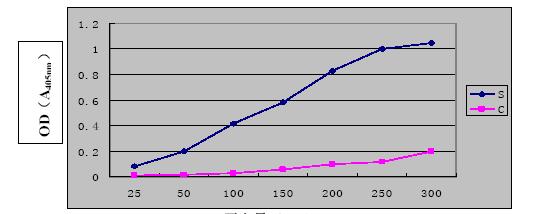
should be subtracted before calculating fold increase in Caspase-3 activity. VI. EXAMPLES OF USING THE KIT JK cells were cultured in an incubator containing 5% CO 2 at 37℃ and stimulated by H2O2 for 6 hours to induce apoptosis. The procedure was done as instrument manual described.
Caspase-3 Colorimetric Assay Kit
he Caspase-3 Colorimetric Assay Kit provides a simple and convenient way for assaying the activity of caspase. Caspase (Cysteine-requiring Aspartate Protease) is a protease family, and it plays a very important role in the period of apoptosis. More researches of Caspase-3 have been done in mammalian cells. The assay is based on spectrophotometric detection of the chromophore pnitroanilide (pNA) after cleavage from the labeled substrate DEVD -pNA. The pNA can be quantified using a spectrophotometer or a microtiter plate reader at 400 nm or 405nm. Comparison the absorbance of pNA from apoptotic samples with a negative control, it can determine the changes of Caspase-3 activity.
Ship worldwide. Contact order@enogene.com for ordering and bulk pricing or contact your local distributor.
Description
he Caspase-3 Colorimetric Assay Kit provides a simple and convenient way for assaying the activity of caspase. Caspase (Cysteine-requiring Aspartate Protease) is a protease family, and it plays a very important role in the period of apoptosis. More researches of Caspase-3 have been done in mammalian cells. The assay is based on spectrophotometric detection of the chromophore pnitroanilide (pNA) after cleavage from the labeled substrate DEVD -pNA. The pNA can be quantified using a spectrophotometer or a microtiter plate reader at 400 nm or 405nm. Comparison the absorbance of pNA from apoptotic samples with a negative control, it can determine the changes of Caspase-3 activity.
Product Information
• Aliquot enough 2X Reaction Buffer for the number of assays to be performed. Add DTT into the 2X Reaction Buffer immediately to 10 mM final concentration before use (add 10 μl of 1.0 M DTT stock in per 1ml 2X Reaction Buffer).
• After thawing, store the Lysis Buffer at 4℃.
• Do not expose Caspase-3 Substrate from light.
B. Assay Procedure
1.Induce cells apoptosis with required way and set negative control.
2.Collect cells and wash cells twice with PBS by centrifugation in 2000 rpm for 5 min.
3.Collect 3~5×10⁶ cells, try to remove PBS
4.Add 50µl cold Lysis Buffer into collected cells, mix uniformity (Note: Before using Lysis Buffer, add 0.5 µl DTT into 50 µl Lysis Buffer)
5.Incubate cells on ice for 20~60 min, vortex vibration 3-4 times,10 s per time, or freeze thawing 2-3 times.
6.Centrifugation in 10,000 rpm at 4 ℃ for 1 min.
7.Suck supernatant and transfer to a new tube, put it on ice
8.Get a small quantity supernatant to assay the protein concentration by Bradford or BCA method.
9.Take 50 µl supernatant containing 100~200µg protein. If there is no enough volume, Lysis Buffer can be compensated.
10.Add 50 µl 2×Reaction Buffer (Note: add 0.5 µl DTT into 50 µl 2×Reaction Buffer)
11.Add 5 µl Caspase-3 Substrate and incubate away from light at 37℃ for 4 hours.
12.Determine extinction value of samples by a spectrophotometer (using a 100 μl micro quartz cuvet) or a microtiter plate reader at 400 nm or 405nm. Get the result of the induced group’s Caspase-3 activity by computing ODinducer/ODnegtive control.
Note: Background of cell lysates buffers from the readings of induced samples and negative control should be subtracted before calculating fold increase in Caspase-3 activity.

Categories by research area
Categories by product type
- Antibodies
- Primary Antibodies
- Tag antibodies
- Internal control antibodies
- Pathological (Immunohistochemistry, IHC) antibodies
- Cell Signal Transduction Research Antibodies
- Secondary Antibody
- Antibody Sampler Kits
- ELISA Kits
- Recombinant Proteins
- Fluorescence Reagents
- Signal Inhibitors and Activators
- Transfection Reagent
- Cell biology kits
- Overexpression Cell Lines
- Cell Lysates
- Purification Resins
- 2019-nCoV & Monkeypox