World supplier of antibodies, antigens and kits since 2007

ELISA Kits
$595/
QuantityTotal: $595
Ship worldwide. Contact order@enogene.com for ordering and bulk pricing or contact your local distributor.
Product Information
DescriptionThis kit allows for the determination of S-100BB concentrations in Human serum, cell culture supernates and other biological fluids.
Principle of the assay:
The kit assay Human S-100BB level in the sample, use Purified Human S-100BB antibody to coat microtiter plate wells, make solid-phase antibody, then add S-100BB samples to wells, combined S-100BB antibody with HRP labeled, form antibody- antigen- enzyme-antibody complex, after washing completely, add TMB substrate solution,TMB substrate becomes blue color at HRP enzyme-catalyzed, reaction is terminated by the addition of a sulphuric acid solution and the color change is measured spectrophotometrically at a wavelength of 450 nm. The concentration of Human S-100BB in the samples is then determined by comparing the O.D. of the samples to the standard curve.
Materials provided with the kit:
1
wash solution
20 ml × 1 bottle
7
Stop Solution
6 ml × 1 bottle
2
HRP-Conjugate reagent
6 ml × 1 bottle
8
Standard
(1600ng/L)
0.5 ml ×1 bottle
3
Micro elisa strip plate
12 well × 8 strips
9
Standard diluent
1.5 ml × 1bottle
4
Samples of intracellular proteins: Many of the proteins to be tested are not secretory proteins. To detect the proteins in cells, the cells need to be collected, washed, and then the cells are broken by ultrasound, and the supernatant is centrifuged.(1)Cultured cells
A. Animal cells: The cell suspension was diluted with PBS of ph7.2-7.4 to make the cell concentration reach about 1 million/ml. It is broken by ultrasonic wave to destroy cells and release intracellular components. Centrifugation at 2-8 ℃ for about 20 minutes (2000-3000 RPM), collect the supernatant carefully, and centrifuge again if there is precipitation during storage.
B. Plant cells: The cell suspension was diluted with PBS of PH7.2-7.4, and the cell concentration reached about 1 million/ml. The cell suspension was placed on an ice box. The cell was broken for 2 seconds and cooled for 30 seconds by an ultrasonic breaker, so that the cell could be destroyed and the cell components could be released. Centrifuge at 2-8 C for about 20 minutes (2000-3000 rpm). Carefully collect the supernatant. If precipitation forms during storage, it should be centrifuged again.
(2)Cells of tissue
After cutting specimens, 1 g of tissue was weighed and 9 mL of PBS at pH 7.2-7.4 was added. The specimens were fully homogenized by hand or homogenizer. Centrifuge at 2-8 C for about 20 minutes (2000-3000 rpm). Remove the supernatant and wash the precipitated cells carefully with PBS at pH 7.2-7.4 for three times. Then the cells were broken by the above method.
Pharyngeal swab: Add 2 ml of PBS at pH 7.2-7.4, dissolve the head of the swab, shake it well, take out the swab with tweezers and squeeze the liquid dry, centrifuge at 2-8 C for about 20 minutes (2000-3000 rpm). Carefully collect the supernatant. Pack one part to be tested and the rest to be frozen for reserve. If precipitation forms during storage, centrifuge again. If it is to measure secretory proteins, take the supernatant directly to detect, test intracellular proteins, to break up cells.
Plant specimens:
A.The fresh weight of each sample should not be less than 50mg;
B.The proportion of tissue homogenate was 10%, that is, 1g tissue was added with 9ml homogenate, PBS was used for homogenization, the concentration was 0.01mol/l, and the pH value was controlled in 7.2-7.4. If the sample weight is adjusted, the corresponding uniform slurry can be adjusted according to the ratio of 1:9;
C.Cut the leaf tissue, put it into a bowl, grind it into powder with liquid nitrogen, and add the amount of homogenized liquid after conversion;
D.The supernatant was centrifuged at 4000-5000 rpm for 15 minutes.
Specimen requirements:
Extract as soon as possible after Specimen collection,and according to the relevant literature, and should be experiment as soon as possible after the extraction. If it can’t, specimen can be kept in -20 ℃ to preserve, Avoid repeated freeze-thaw cycles.
Can't detect the sample which contain NaN3, because NaN3 inhibits HRP active.
The above is a general sample processing method, which can not cover all kinds of samples. For some special samples, it is suggested that the experimenters refer to the published literature and design a reasonable sample processing method by themselves.
Assayrange:20ng/L -800ng/L
Storage/Stability2-8℃Validity: six months
Important notes:
This kit is used for scientific research, but not for clinical diagnosis.
2. Please use this kit within the validity period of the labeling.
3. Reagents in the kit should not be mixed with other batches of reagents or reagents from other sources.
4. The kit should be removed from the refrigerated environment after 15-30 minutes of room temperature balance. If the enzyme label is not used up after opening, the strip should be stored in a sealed bag.
5. The binding reaction will be affected by the dilution of any standard product, operator, liquid transfer technology, washing technology, incubation temperature, and the change of the storage time of the kit.
6. The kit is designed to remove or reduce some endogenous interference factors in biological samples, not all possible factors have been removed.
7. Concentrated detergent may crystallize. When diluted, it can be heated and dissolved in the water bath without affecting the results of washing.
8. Sampling adders should be used at all steps and their accuracy should be checked regularly to avoid test errors. The best time to add samples is within 5 minutes. If the number of samples is large, it is recommended to use volleyball.
9. Please make standard curves at the same time of each measurement. It's better to make multiple holes. If the content of the substance to be measured in the sample is too high (OD value of the sample is greater than OD value of the first hole of the standard pore), please dilute the sample diluent for a certain number of times (n times) and then determine. When calculating, please multiply the total dilution multiple (*n*5).
10. Sealing film can only be used once to avoid cross-contamination.
11. Substrates should be kept away from light.
12. Strictly follow the instructions. The results of the test must be determined by the reading of the enzyme label.
13. All samples, detergents and all kinds of waste should be treated as infectious substances.
14. The reagent components of different batches should not be mixed.
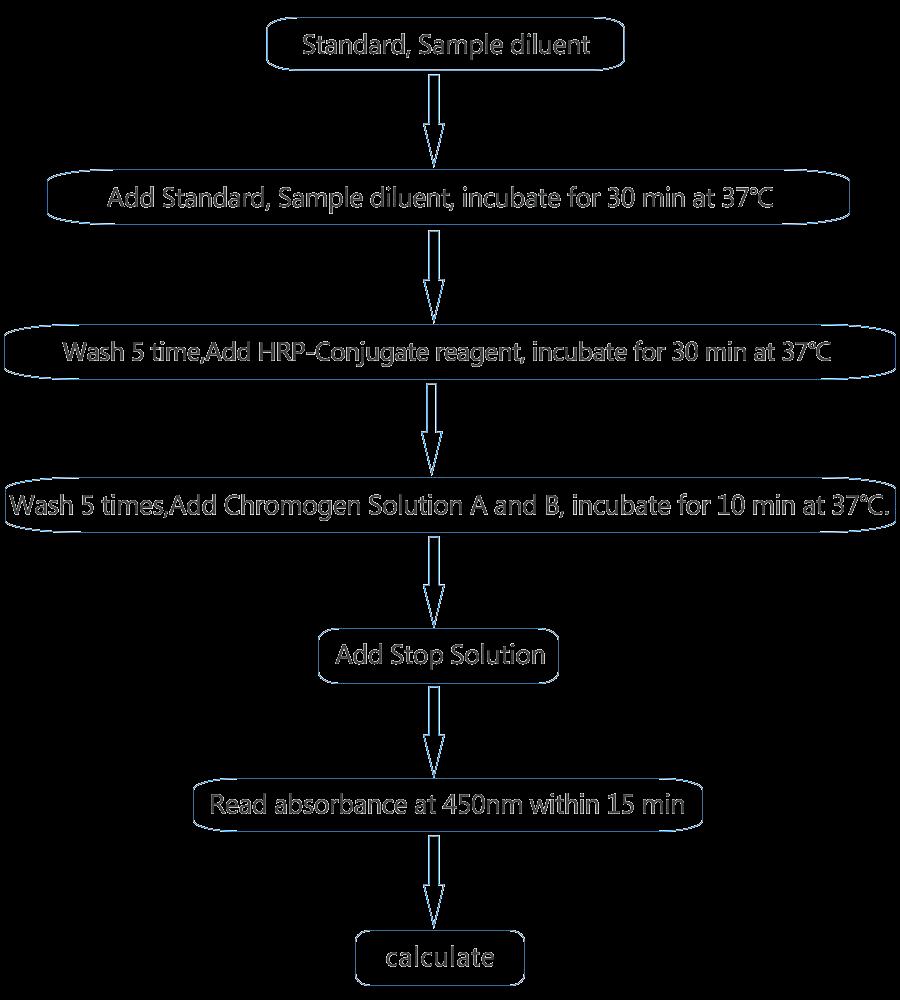
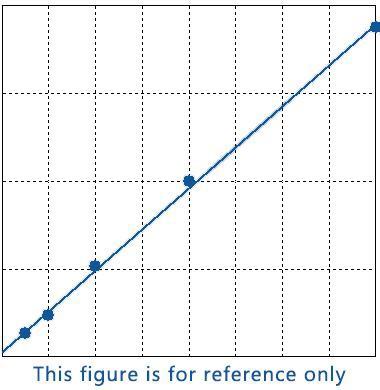
Take the standard density as the horizontal, the OD value for the vertical ,draw the standard curve on graph paper, Find out the corresponding density according to the sample OD value by the Sample curve, multiplied by the dilution multiple, or calculate the straight line regression equation of the standard curve with the standard density and the OD value ,with the sample OD value in the equation, calculate the sample density, multiplied by the dilution factor, the result is the sample actual density.
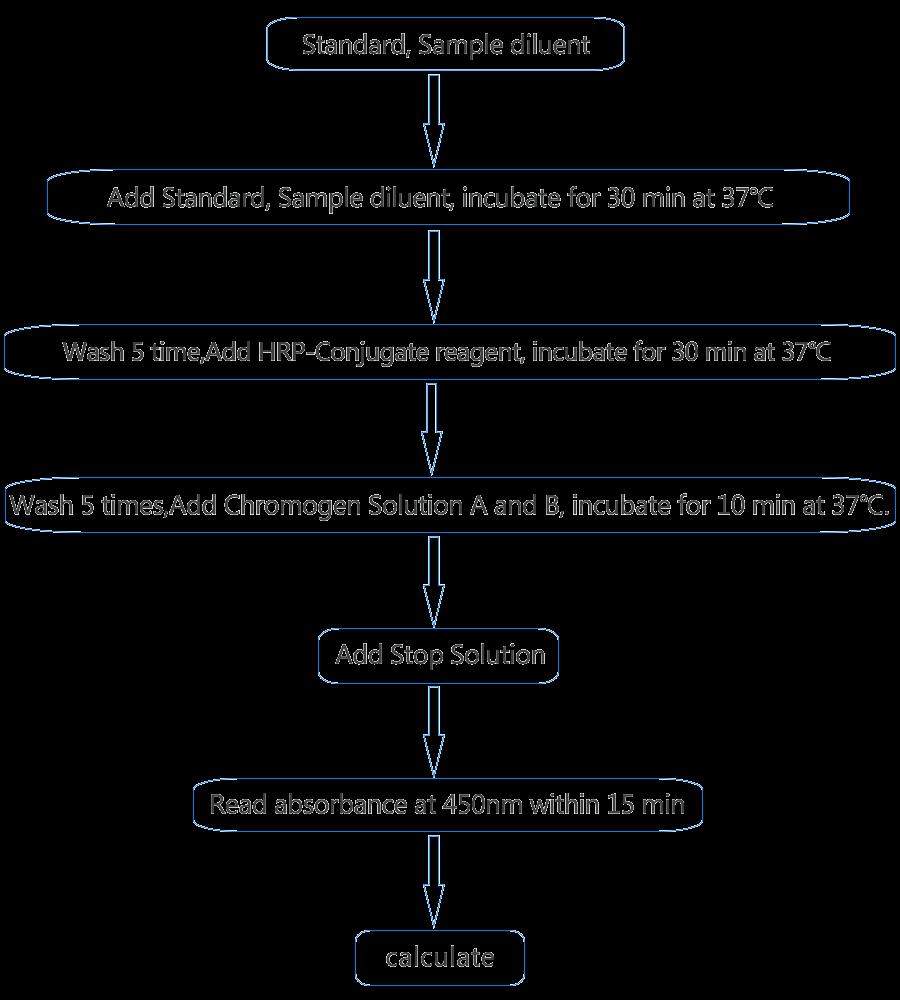
standard density as the horizontal, the OD value for the vertical ,draw the standard Find out the corresponding density according to the sample OD value by the by the dilution multiple, or calculate the straight line regression equation of the standard density and the OD value ,with the sample OD value in the equation, density, multiplied by the dilution factor, the result is the sample actual density.

Categories by research area
Categories by product type
- Antibodies
- Primary Antibodies
- Tag antibodies
- Internal control antibodies
- Pathological (Immunohistochemistry, IHC) antibodies
- Cell Signal Transduction Research Antibodies
- Secondary Antibody
- Antibody Sampler Kits
- ELISA Kits
- Recombinant Proteins
- Fluorescence Reagents
- Signal Inhibitors and Activators
- Transfection Reagent
- Cell biology kits
- Overexpression Cell Lines
- Cell Lysates
- Purification Resins
- 2019-nCoV & Monkeypox