World supplier of antibodies, antigens and kits since 2007

2019-nCoV & Monkeypox
SARS-CoV-2 (2019-nCoV) Spike Protein (RBD, mFc Tag)
2019nCoVExpression Host:HEK293 Cells
$595/ 50ug
QuantityTotal: $595
Ship worldwide. Contact order@enogene.com for ordering and bulk pricing or contact your local distributor.
Product Information
NameSARS-CoV-2 (2019-nCoV) Spike Protein (RBD, mFc Tag)
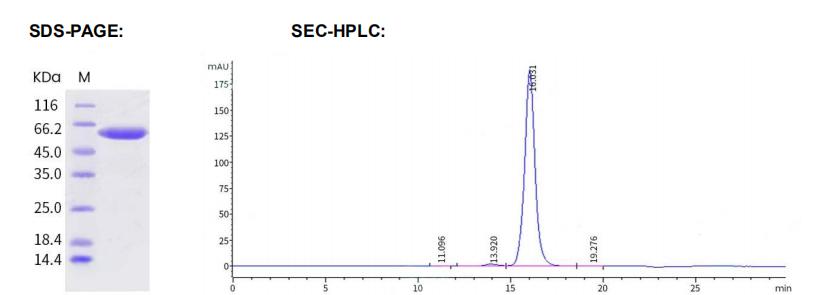
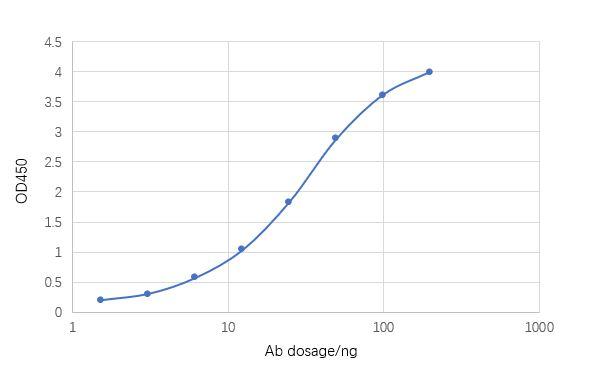
Purity> 95 % as determined by SDS-PAGE.> 95 % as determined by SEC-HPLCBio Activity:1. Measured by its binding ability in a functional ELISA. Immobilized human ACE2 protein (His tag) at 2μg/mL (100μL/well) can bind SARS-CoV-2 (2019-nCoV) Spike Protein (RBD, mFc Tag)(ZD2019-P6), the EC50 of SARS-CoV-2 (2019-nCoV) Spike Protein (RBD, mFc Tag) is 15-50 ng/mL. 2. Loaded Human ACE2 Protein (His tag) on SA Biosensor, can bind SARS-CoV-2/2019-nCoV Spike/RBD Protein (RBD, mFc Tag) with an affinity constant of 0.562 nM as determined by Octet RED System.
Endotoxin< 1.0 EU per μg protein as determined by the LAL method.Predicted N terminal: Arg 319Molecular Mass: The recombinant SARS-CoV-2 (2019-nCoV) Spike Protein (RBD, mFc Tag) consists of 457 amino acids and predicts a molecular mass of 51.5 kDa.
FormulationLiquid or lyophilized from sterile PBS, pH 7.4. Normally 5 % - 8 % trehalose, mannitol and 0.01% Tween80 are added as protectants before lyophilization.Stability & Storage: Samples are stable for twelve months from date of receipt at -20℃ to -80℃. Store it under sterile conditions at -20℃ to -80℃ upon receiving. Recommend to aliquot the protein into smaller quantities for optimal storage. Avoid repeated freeze-thaw cycles.
Gene NameSynonym:coronavirus spike; cov spike; ncov RBD; ncov s1; ncov s2; ncov spike; NCP-CoV RBD; NCP-CoV s1; NCP-CoV s2; NCPCoV Spike; novel coronavirus RBD; novel coronavirus s1; novel coronavirus s2; novel coronavirus spike; RBD; S1; S2; Spike RBDProtein Construction:A DNA sequence encoding the SARS-CoV-2 (2019-nCoV) Spike Protein (RBD) (YP_009724390.1) (Arg319-Phe541) was expressed with the Fc region of mouse IgG1 at the C-terminus.
References1. Shen S, et al. (2007) Expression, glycosylation, and modification of the spike (S) glycoprotein of SARS CoV. Methods Mol Biol. 379: 127-35.
2. Du L, et al. (2009) The spike protein of SARS-CoV--a target for vaccine and therapeutic development. Nat Rev Microbiol. 7 (3): 226-36.
3. Xiao X, et al. (2004) The SARS-CoV S glycoprotein. Cell Mol Life Sci. 61 (19-20): 2428-30.
2. Du L, et al. (2009) The spike protein of SARS-CoV--a target for vaccine and therapeutic development. Nat Rev Microbiol. 7 (3): 226-36.
3. Xiao X, et al. (2004) The SARS-CoV S glycoprotein. Cell Mol Life Sci. 61 (19-20): 2428-30.
Price595$
Order: order@enogene.com Support: service@enogene.com Web: www.enogene.com

Protein Description:The spike (S) glycoprotein of coronaviruses contains protrusions that will only bind to certain receptors on the host cell. Known receptors bind S1 are ACE2, angiotensin-converting enzyme 2; DPP4, dipeptidyl peptidase-4; APN, aminopeptidase N; CEACAM, carcinoembryonic antigen-related cell adhesion molecule 1; Sia, sialic acid; O-ac Sia, O-acetylated sialic acid. The spike is essential for both host specificity and viral infectivity. The term 'peplomer' is typically used to refer to
Conjugated Antibody
This product is also available conjugated. Format: E27D2019-P6-Conjugate. Price: $485 / Size: 100μl.
E27D2019-P6-FITC$485 / 100μlE27D2019-P6-Biotin$485 / 100μlE27D2019-P6-HRP$485 / 100μlE27D2019-P6-AP$485 / 100μlE27D2019-P6-AF350$485 / 100μlE27D2019-P6-AF405M$485 / 100μlE27D2019-P6-AF488$485 / 100μlE27D2019-P6-AF514$485 / 100μlE27D2019-P6-AF532$485 / 100μlE27D2019-P6-AF555$485 / 100μlE27D2019-P6-AF568$485 / 100μlE27D2019-P6-AF405S$485 / 100μlE27D2019-P6-AF405L$485 / 100μlE27D2019-P6-AF546$485 / 100μlE27D2019-P6-AF594$485 / 100μlE27D2019-P6-AF610$485 / 100μlE27D2019-P6-AF635$485 / 100μlE27D2019-P6-AF647$485 / 100μlE27D2019-P6-AF680$485 / 100μlE27D2019-P6-AF700$485 / 100μlE27D2019-P6-AF750$485 / 100μlE27D2019-P6-AF790$485 / 100μlE27D2019-P6-APC$485 / 100μlE27D2019-P6-PE$485 / 100μlE27D2019-P6-Cy3$485 / 100μlE27D2019-P6-Cy5$485 / 100μlE27D2019-P6-Cy5.5$485 / 100μlE27D2019-P6-Cy7$485 / 100μlE27D2019-P6-PE-Cy5$485 / 100μl
Contact order@enogene.com to order conjugated formats. Magnetic Beads (1-30μm) conjugation is also available.
Related Products
Categories by research area
Categories by product type
- Antibodies
- Primary Antibodies
- Tag antibodies
- Internal control antibodies
- Pathological (Immunohistochemistry, IHC) antibodies
- Cell Signal Transduction Research Antibodies
- Secondary Antibody
- Antibody Sampler Kits
- ELISA Kits
- Recombinant Proteins
- Fluorescence Reagents
- Signal Inhibitors and Activators
- Transfection Reagent
- Cell biology kits
- Overexpression Cell Lines
- Cell Lysates
- Purification Resins
- 2019-nCoV & Monkeypox