World supplier of antibodies, antigens and kits since 2007

Other Products
Price on request
Quantity
Ship worldwide. Contact order@enogene.com for ordering and bulk pricing or contact your local distributor.
Product Information
Sample1% acetone in water, load 1% CVFlow velocity: 30 cm/h
Detector: Absorption by UV 280 nm
Calculate column efficiency:The column efficiency can be evaluated by the number of theoretical plates per meter chromatography bed (N) or by H (height equivalent to a theoretical plate, HETP) and As (Asymmetry factor) in following ways:
Detector: Absorption by UV 280 nm
Calculate column efficiency:The column efficiency can be evaluated by the number of theoretical plates per meter chromatography bed (N) or by H (height equivalent to a theoretical plate, HETP) and As (Asymmetry factor) in following ways:
Purificationprotocols:To maintain the lifetime of the medium, samples should be centrifuged and filtered by a 0.22/0.45 μm membrane before loading to the column. Make sure pH and ionic strength of your sample are the same with your binding buffer, so that a good binding performance can be achieved.
1. Washing
•Wash the column with 5 CV distilled water.
•Recommended flow velocity: 90-150 cm/h.
2. Binding
•Equilibrate the column with at least 5 CV binding buffer.
•Recommended flow velocity: 90-150 cm / h.
•The composition of the binding buffer should be optimized according to the properties of the target IgG.
•Recommended binding buffer:
20 mM sodium phosphate or 50 mM Tris, pH 7.0
3. Sample loading
•Load the pretreated sample. The flow velocity should be optimized according to the sample.
•Recommended flow velocity: 90-150 cm/h.
4. Washing
•Wash with wash buffer until the baseline is stable.
•Recommended flow velocity: 90-150 cm/h.
5. Elution
•To elute very strongly binding IgG it may be necessary to lower the pH below 3.0. To preserve the activity of acid labile IgGs, we recommend to add 60 – 200 µl, of 1 M Tris-HCl, pH 9.0, to neutralize the eluted fractions.
•Recommended elution buffer:
20 mM sodium acetate, pH 3.0-4.0
or 0.1 M glycine, pH 3.0
6. Regeneration
•After each purification cycle, regenerate the medium by washing with approximately 3 bed volumes of elution buffer until the base line is stable, followed by at least 3 column volumes of binding buffer.
Cleaning-in-Place (CIP):
After long-term using of the medium, too many contaminants can increase the backpressure of the column which decrease the column efficiency and the capacity, even damage the life-time of the medium.
Regular CIP cleaning can effectively protect medium. CIP cleaning can be performed every 1-5 times, if the medium is slightly polluted. But, for serious polluted medium after experiment, CIP cleaning must be performed immediately.
The medium can be cleaned by the following methods:
•Wash with 2 column volumes of 6 M guanidine hydrochloride followed by immediately ~10 CV of distilled water.
•Wash the column with a non-ionic detergent (e.g. Triton X-100), 0.1%, at 37 ℃, contact time one minute. Followed by immediately ~10 CV of distilled water.
•Wash with 0.2 M NaOH with a contact time at least 5 minutes followed by immediately ~10 CV distilled water.
Storage/StabilityStore the medium for longer periods of time in 20% ethanol at +4 to +8 ℃. Do not freeze the medium.Ordering information:
Product
Product
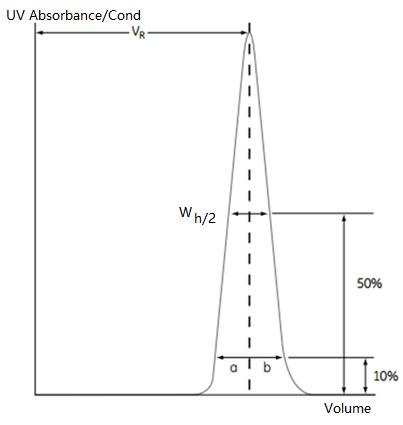
Flow velocity: 30 cm/h Detector: Absorption by UV 280 nm Calculate column efficiency:The column efficiency can plates per meter chromatography bed (N) or by H (height


Categories by research area
Categories by product type
- Antibodies
- Primary Antibodies
- Tag antibodies
- Internal control antibodies
- Pathological (Immunohistochemistry, IHC) antibodies
- Cell Signal Transduction Research Antibodies
- Secondary Antibody
- Antibody Sampler Kits
- ELISA Kits
- Recombinant Proteins
- Fluorescence Reagents
- Signal Inhibitors and Activators
- Transfection Reagent
- Cell biology kits
- Overexpression Cell Lines
- Cell Lysates
- Purification Resins
- 2019-nCoV & Monkeypox