World supplier of antibodies, antigens and kits since 2007

ELISA Kits
Human AFP ELISA kit
$395/
QuantityTotal: $395
Ship worldwide. Contact order@enogene.com for ordering and bulk pricing or contact your local distributor.
Price395$
Product Information
Intended useThe AFP ELISA Kit is intended for the quantitative measurement of AFP in human serum.
Summary and explanationAlpha fetoprotein (AFP) is a glycoprotein with a molecular weigh of approximately 70,000 Daltons. AFP is normally produced during fetal and neonatal development by the liver, yolksac, and in small concentrations by the gastrointestinal tract. After birth, serum AFP concentrations decrease rapidly, and by the second year of life and thereafter only trace amounts are normally detected in serum.Elevation of serum AFP to abnormally high values occurs in several malignant diseases, most notably nonseminomatous testicular cancer and primary hepatocellular carcinoma. In the case of nonseminomatous testicular cancer, a direct relationship has been observed between the incidence of elevated AFP levels and the stage of disease. Elevated AFP levels have also been observed in patients diagnosed with seminoma with nonseminomatous elements, but not in patients with pure seminoma. In addition, elevated serum AFP concentrations have been measured in patients with other noncancerous diseases, including ataxia telangiectasia, hereditary tyrosinemia, neonatal hyperbilirubinemia, acute viral hepatitis, chronic active hepatitis, and cirrhosis. Elevated serum AFP concentrations are also observed in pregnant women. Therefore, AFP measurements are not recommended for use as a screening procedure to detect the presence of cancer in the general population.
Principle of the testThis AFP ELISA kit is a solid phase sandwich assay method, based on a streptavidin-biotin principle. The standards, samples and the biotinylated Anti-AFP antibody reagent are added into designated wells, coated with Streptavidin. Endogenous AFP in the patient’s serum binds to the antigenic site of the biotinylated Anti-AFP antibody. Simultaneously, the biotinylated antibody is immobilized onto the wells through the high affinity Streptavidin-Biotin interaction. Unbound protein and excess biotin conjugated antibody are washed off by wash buffer. Upon the addition of the Peroxidase (HRP) conjugated Anti-AFP antibody reagent, a sandwich complex is formed, the analyte of interest being in between the two highly specific antibodies, labeled with Biotin and HRP. Unbound protein excess enzyme conjugated antibody reagent is washed off by wash buffer. Upon the addition of the substrate, the intensity of color developed is directly proportional to the concentration of AFP in the samples. A standard curve is prepared relating color intensity to the concentration of the AFP.MATERIALS PROVIDED96 Tests1. Microwell coated with Streptavidin12x8x12. AFP Standard: 6 vials (ready to use)0.5ml3. Anti-AFP Enzyme Conjugate: 1 bottle (ready to use)12ml4. Anti-AFP-Biotin Reagent: 1 bottle (ready to use)12ml5. TMB Substrate: 1 bottle (ready to use)12ml6. Stop Solution: 1 bottle (ready to use)12ml7. 20X Wash concentrate: 1 bottle25ml
Materials not provided1. Distilled or deionized water2. Precision pipettes3. Disposable pipette tips4. ELISA reader capable of reading absorbance at 450nm5. Absorbance paper or paper towel6. Graph paper
Storage and stability1. Store the kit at 2 - 8 C.2. Keep microwells sealed in a dry bag with desiccants.3. The reagents are stable until expiration of the kit.4. Do not expose test reagents to heat, sun, or strong light.
Warnings and precautions1. Potential biohazardous materials:The calibrator and controls contain human source components which have been tested and found non-reactive for hepatitis B surface antigen as well as HIV antibody. However, as there is no test method that can offer complete assurance that HIV, Hepatitis B virus or other infectious agents are absent, these reagents should be handled at the Biosafety Level 2.2. Do not pipette by mouth. Do not smoke, eat, or drink in the areas in which specimens or kit reagents are handled.3. The components in this kit are intended for use as an integral unit. The components of different lots should not be mixed.4. It is recommended that serum samples be run in duplicate.5. Optimal results will be obtained by strict adherence to this protocol. Accurate and precise pipetting, as well as following the exact time and temperature requirements prescribed are essential. Any deviation from this may yield invalid data.
Specimen collection handling1. Collect blood specimens and separate the serum immediately.2. Specimens may be stored refrigerated at (2-8C) for 5 days. If storage time exceeds 5 days, store frozen at (-20 C) for up to one month.3. Avoid multiple freeze-thaw cycles.4. Prior to assay, frozen sera should be completely thawed and mixed well.5. Do not use grossly lipemic specimens.
Reagents preparationPrepare 1X Wash buffer by adding the contents of the bottle (25 ml, 20X) to 475 ml of distilled or deionized water. Store at room temperature (18-26 C).
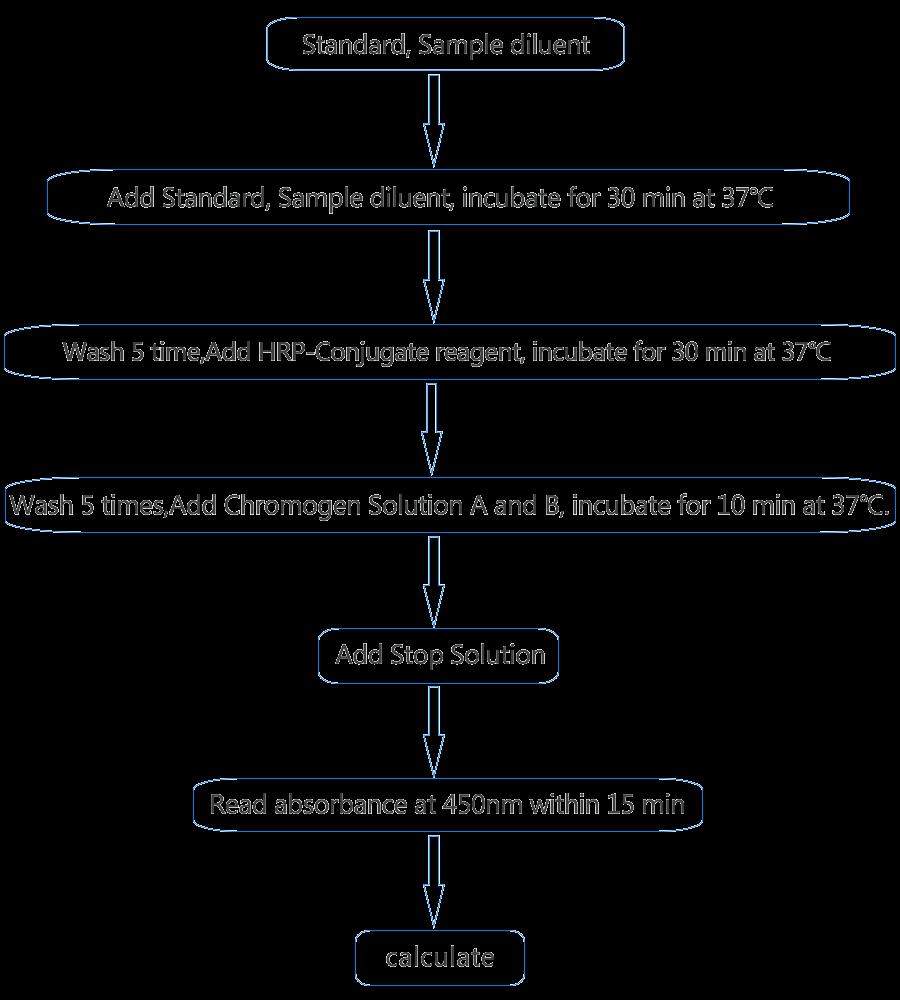
Assay procedurePrior to assay, allow reagents to stand at room temperature. Gently mix all reagents before use.1. Place the desired number of coated strips into the holder2. Pipette 25 l of AFP standards, control and patient’s sera.3. Add 100 l of Anti-AFP-Biotin Reagent to all wells and mix for 20-30 seconds.4. Cover the plate and incubate for 30 minutes at room temperature (18-26 C).5. Remove liquid from all wells. Wash wells three times 300 l with 1X wash buffer. Blot on absorbent paper towels.6. Add 100 l of the Anti-AFP- Enzyme conjugate to all wells. Cover and incubate for 30 minutes.7. Remove liquid from all wells. Wash wells three times 300 l with 1X wash buffer. Blot on absorbent paper towels.8. Add 100 l of TMB substrate to all wells.9. Incubate for 15 minutes at room temperature.10. Add 50 l of stop solution to all wells. Shake the plate gently to mix the solution.11. Read absorbance on ELISA Reader at 450 nm within 15 minutes after adding the stopping solution.
Calculation of resultsThe standard curve is constructed as follows:1. Check AFP standard value on each standard vial. This value might vary from lot to lot. Make sure you check the value on every kit. See example of the standard attached.2. To construct the standard curve, plot the absorbance for the AFP standards (vertical axis) versus theAFP standard concentrations in ng/ml (horizontal axis) on a linear graph paper. Draw the best curvethrough the points.Read the absorbance for controls and each unknown sample from the curve. Record the value for each control or unknown sample.Example of a Standard DataOD 450 nmConc.ng/mLStd 10.0200Std 20.0725Std 30.28125Std 40.46250Std 51.878250Std 62.447500
Limitations of the testDo not use sodium azide as preservative. Sodium azide inhibits HRP enzyme activities.
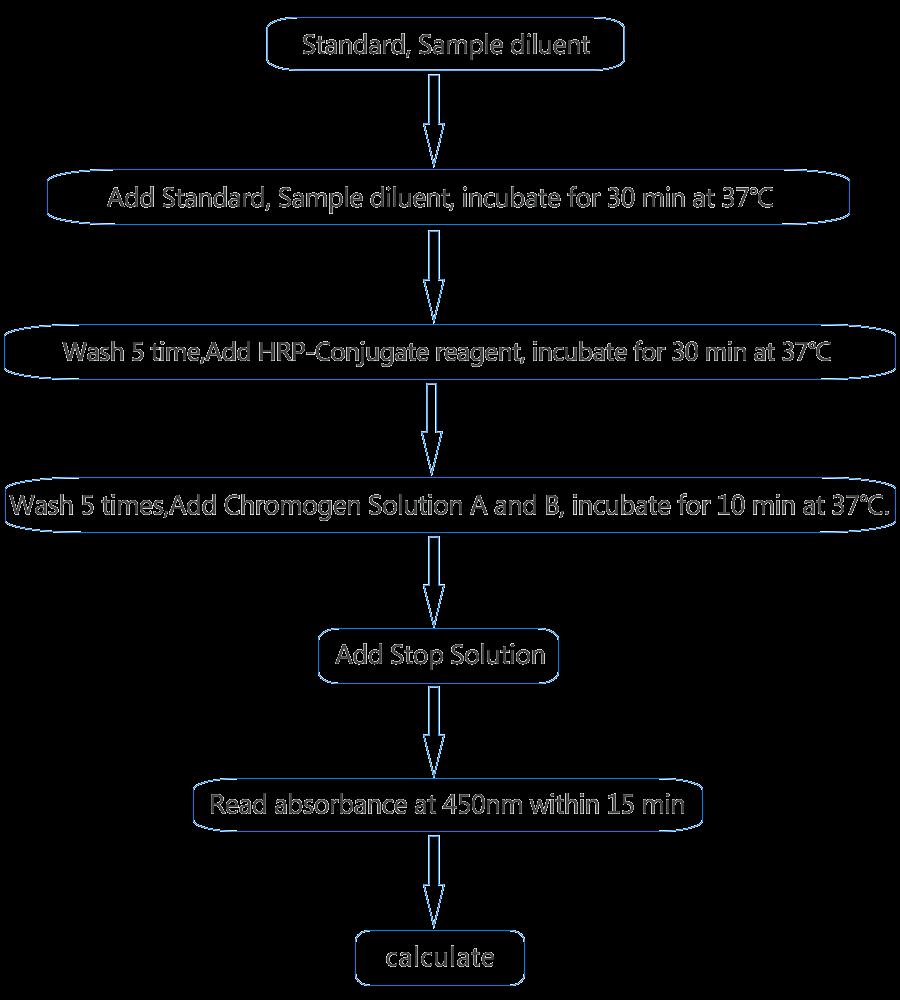

standard density as the horizontal, the OD value for the vertical ,draw curve on graph paper, Find out the corresponding density according value by the Sample curve, multiplied by the dilution multiple, or calculate regression equation of the standard curve with the standard density ,with the sample OD value in the equation, calculate the sample the dilution factor, the result is the sample actual density.

Categories by research area
Categories by product type
- Antibodies
- Primary Antibodies
- Tag antibodies
- Internal control antibodies
- Pathological (Immunohistochemistry, IHC) antibodies
- Cell Signal Transduction Research Antibodies
- Secondary Antibody
- Antibody Sampler Kits
- ELISA Kits
- Recombinant Proteins
- Fluorescence Reagents
- Signal Inhibitors and Activators
- Transfection Reagent
- Cell biology kits
- Overexpression Cell Lines
- Cell Lysates
- Purification Resins
- 2019-nCoV & Monkeypox