World supplier of antibodies, antigens and kits since 2007

2019-nCoV & Monkeypox
Recombinant Human ACE-2 (C-Fc)
Price on request
Quantity
Ship worldwide. Contact order@enogene.com for ordering and bulk pricing or contact your local distributor.
Specificty Sensitivity
Specificity/SensitivityHuman
Product Information
PurityGreater than 95% as determined by reducing SDS-PAGE. Endotoxin: Less than 0.1 ng/µg (1 EU/µg) as determined by LAL test.
DescriptionRecombinant Human Angiotensin-Converting Enzyme 2 is produced by Mammalian expression system and the target gene encoding Gln18-Ser740 is expressed with a Fc tag at the C-terminus.
FormulationSupplied as a 0.2 μm filtered solution of 20mMTris,300mMNacl,1mMZncl2,10%Glycerol,PH7.4.
FormName:Recombinant Human ACE-2 (C-Fc), Accession #: Q9BYF1
Other NamesAngiotensin-Converting Enzyme 2; ACE-Related Carboxypeptidase; Angiotensin-Converting Enzyme Homolog; ACEH; Metalloprotease MPROT15; ACE2
Storage/StabilityStore at < -20°C, stable for 6 months after receipt.
BackgroundAngiotensin-Converting Enzyme 2 (ACE-2) is an integral membrane protein and a zinc metalloprotease of the ACE family, the ACE family includes somatic and germinal ACE. ACE-2 cleaves angiotensins I and II as a carboxypeptidase, ACE-2 converts angiotensin I to angiotensin 1-9, and angiotensin II to angiotensin 1-7. ACE-2 is also able to hydrolyze apelin-13 and dynorphin-13 with high efficiency. ACE-2 can be high expressed in testis, kidney and heart, in colon, small intestine and ovary at moderate levels. Captopril and lisinopril as the classical ACE inhibitor don’t inhibit ACE-2 activity. ACE-2 may play an important role in regulating the heart function.
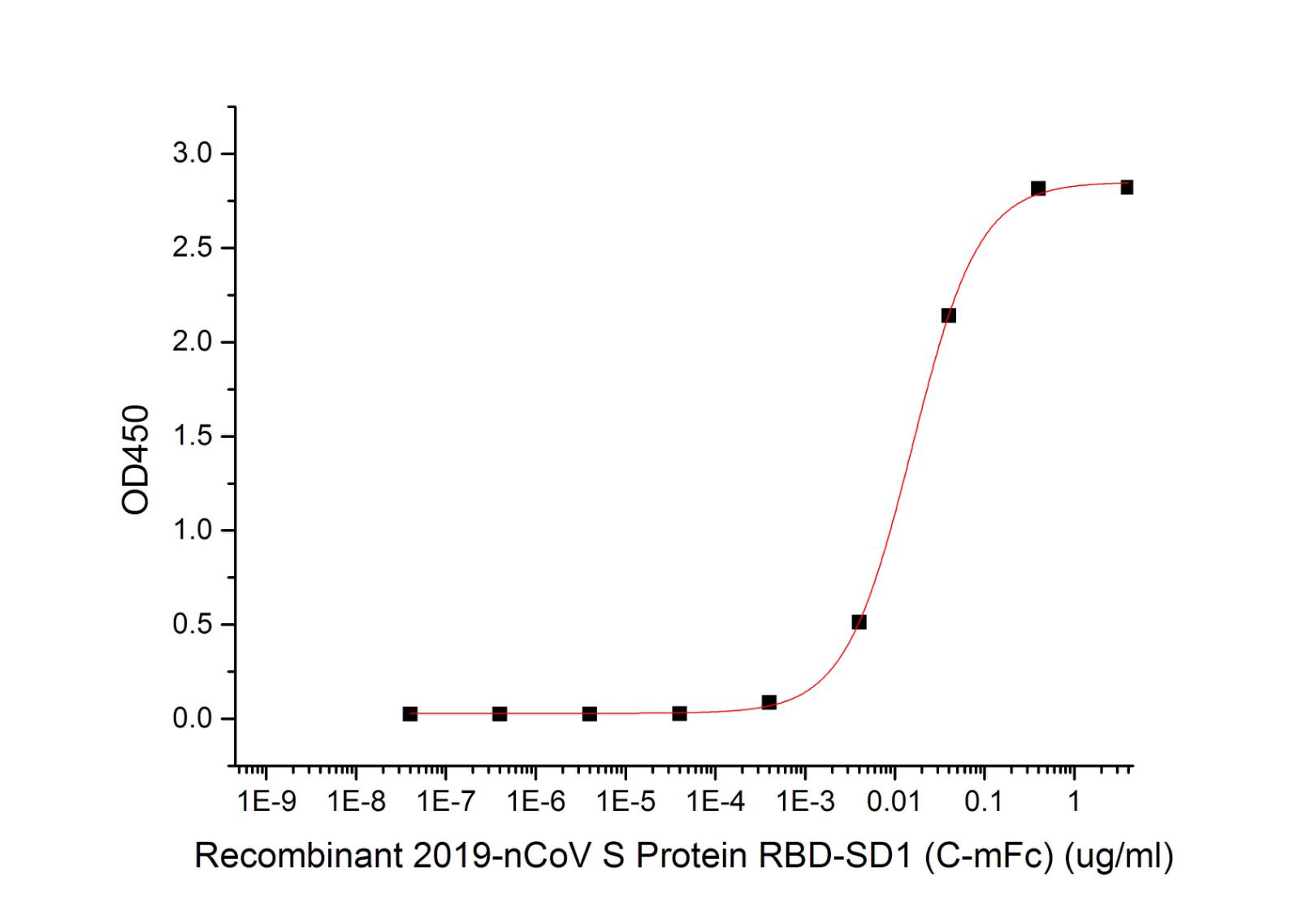
Immobilized Human ACE-2-FC (Cat# E21-O5Y-2) at 2μg/ml (100 μl/well) can bind 2019-nCoV S Protein RBD-SD1-mFc (Cat# E21-RA38-1). The ED50 of Recombinant 2019-nCoV S Protein RBD-mFc(Cat# E21-RA38-1) is 15.5 ng/ml .
Related Products
Categories by research area
Categories by product type
- Antibodies
- Primary Antibodies
- Tag antibodies
- Internal control antibodies
- Pathological (Immunohistochemistry, IHC) antibodies
- Cell Signal Transduction Research Antibodies
- Secondary Antibody
- Antibody Sampler Kits
- ELISA Kits
- Recombinant Proteins
- Fluorescence Reagents
- Signal Inhibitors and Activators
- Transfection Reagent
- Cell biology kits
- Overexpression Cell Lines
- Cell Lysates
- Purification Resins
- 2019-nCoV & Monkeypox