
You are here: EnoGene Home > Products > Cell Signal Transduction Research Antibodies > Peroxin 1 Polyclonal Antibody
Peroxin 1 Polyclonal Antibody
Datasheet
Catalog Number:
E20-73669Amount:
100ulPrice:
225$Purification:
The antibody was affinity-purified from rabbit antiserum by affinity-chromatography using epitope-specific immunogen.Immunogen:
The antiserum was produced against synthesized peptide derived from human PEX1. AA range:1234-1283Source:
Polyclonal, RabbitGene Name:
PEX1Dilution:
Immunohistochemistry: 1/100 - 1/300. ELISA: 1/10000. Not yet tested in other applications.
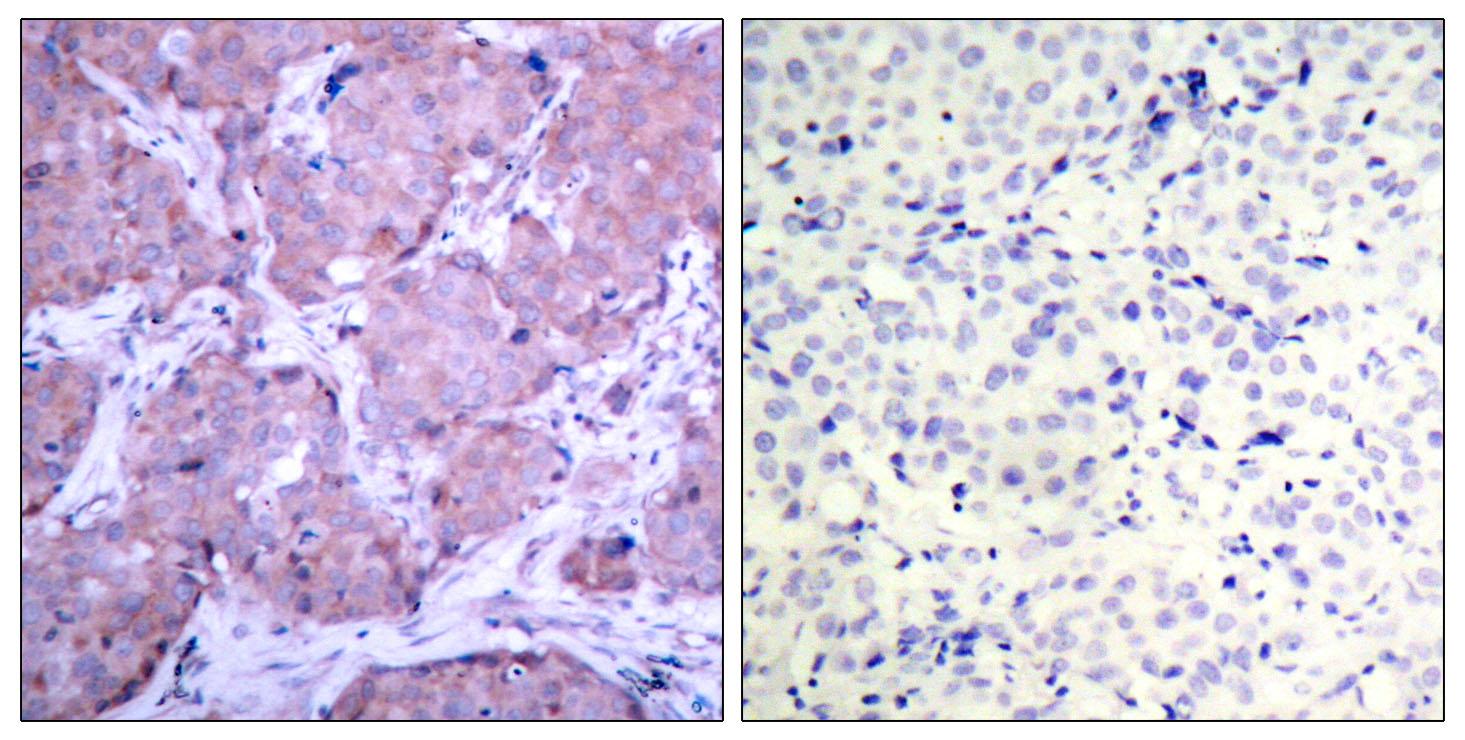
- Immunohistochemistry analysis of paraffin-embedded human breast carcinoma tissue, using PEX1 Antibody. The picture on the right is blocked with the synthesized peptide.
Background:
peroxisomal biogenesis factor 1(PEX1) Homo sapiens This gene encodes a member of the AAA ATPase family, a large group of ATPases associated with diverse cellular activities. This protein is cytoplasmic but is often anchored to a peroxisomal membrane where it forms a heteromeric complex and plays a role in the import of proteins into peroxisomes and peroxisome biogenesis. Mutations in this gene have been associated with complementation group 1 peroxisomal disorders such as neonatal adrenoleukodystrophy, infantile Refsum disease, and Zellweger syndrome. Alternatively spliced transcript variants have been found for this gene. [provided by RefSeq, Sep 2013],Protein Name:
Peroxisome biogenesis factor 1Human Gene Id:
5189Human Swiss Prot No:
O43933Mouse Gene Id:
71382Mouse Swiss Prot No:
Q5BL07Specificity:
Peroxin 1 Polyclonal Antibody detects endogenous levels of Peroxin 1 protein.Formulation:
Liquid in PBS containing 50% glycerol, 0.5% BSA and 0.02% sodium azide.Concentration:
1 mg/mlStorage Stability:
-20°C/1 yearOther Name:
PEX1; Peroxisome biogenesis factor 1; Peroxin-1; Peroxisome biogenesis disorder protein 1MolecularWeight(Da):
142867Function:
disease:Defects in PEX1 are a cause of adrenoleukodystrophy neonatal (NALD) [MIM:202370]. NALD is a peroxisome biogenesis disorder (PBD) characterized by the accumulation of very long-chain fatty acids, adrenal insufficiency and mental retardation.,disease:Defects in PEX1 are a cause of infantile Refsum disease (IRD) [MIM:266510]. IRD is a mild peroxisome biogenesis disorder (PBD). Clinical features include early onset, mental retardation, minor facial dysmorphism, retinopathy, sensorineural hearing deficit, hepatomegaly, osteoporosis, failure to thrive, and hypocholesterolemia. The biochemical abnormalities include accumulation of phytanic acid, very long chain fatty acids (VLCFA), di- and trihydroxycholestanoic acid and pipecolic acid.,disease:Defects in PEX1 are the cause of peroxisome biogenesis disorder complementation group 1 (PBD-CG1) [MIM:602136]; also known as PBD-CGE. PBD referSubcellular Location:
cytoplasm,peroxisome,peroxisomal membrane,cytosol,intracellular membrane-bounded organelle,extracellular exosome,Expression:
Brain,Lymph,Trachea,

Related Products
- PTEN (Phospho-Ser380) Antibody Datasheet
Catalog Number:
E011009-1Amount:
50μg/50μlReactivity:
Human, Mouse, RatApplications:
IHC: 1:50~1:100Swiss-Prot No.:
P60484Price:
145$
- PTEN (Phospho-Ser380) Antibody Datasheet
Catalog Number:
E011009-2Amount:
100μg/100μlReactivity:
Human, Mouse, RatApplications:
IHC: 1:50~1:100Swiss-Prot No.:
P60484Price:
225$
- NFκB-p65 (Phospho-Ser468) Antibody Datasheet
Catalog Number:
E011013-1Amount:
50μg/50μlReactivity:
Human, Mouse, RatApplications:
WB: 1:500~1:1000 IF:1:100~1:200Swiss-Prot No.:
Q04206Price:
145$
- NFκB-p65 (Phospho-Ser468) Antibody Datasheet
Catalog Number:
E011013-2Amount:
100μg/100μlReactivity:
Human, Mouse, RatApplications:
WB: 1:500~1:1000 IF:1:100~1:200Swiss-Prot No.:
Q04206Price:
225$

- Rel (Phospho-Ser503) Antibody Datasheet
Catalog Number:
E011020-1Amount:
50μg/50μlReactivity:
HumanApplications:
IF:1:100~1:200Swiss-Prot No.:
Q04864Price:
145$

Catalog Number
- Amount:100ul
- Price:225$

Contact us
Categories by research area
Categories by product type
- Antibodies
- Tag antibodies
- Internal control antibodies
- Pathological (Immunohistochemistry, IHC) antibodies
- Cell Signal Transduction Research Antibodies
- Secondary Antibody
- Antibody Sampler Kits
- Recombinant Proteins
- Fluorescence Reagents
- Signal Inhibitors and Activators
- Transfection Reagent
- Cell biology kits