
You are here: EnoGene Home > Products > Cell Signal Transduction Research Antibodies > N-Shc Polyclonal Antibody
N-Shc Polyclonal Antibody
Datasheet
Catalog Number:
E20-73196Amount:
100ulPrice:
225$Purification:
The antibody was affinity-purified from rabbit antiserum by affinity-chromatography using epitope-specific immunogen.Immunogen:
The antiserum was produced against synthesized peptide derived from human SHC3. AA range:291-340Source:
Polyclonal, RabbitGene Name:
SHC3Dilution:
Immunohistochemistry: 1/100 - 1/300. ELISA: 1/10000. Not yet tested in other applications.
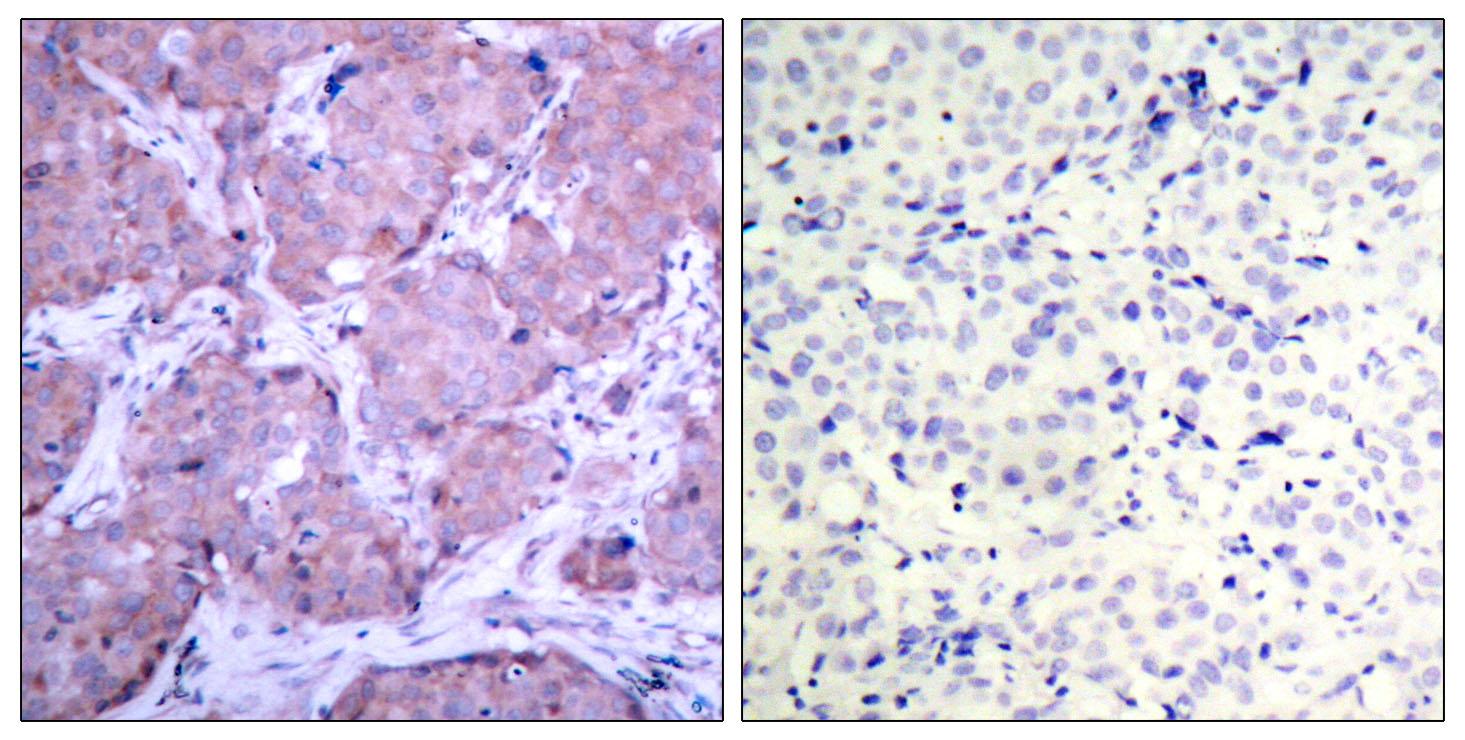
- Immunohistochemistry analysis of paraffin-embedded human lung carcinoma tissue, using SHC3 Antibody. The picture on the right is blocked with the synthesized peptide.
Background:
function:Signaling adapter that couples activated growth factor receptors to signaling pathway in neurons. Involved in the signal transduction pathways of neurotrophin-activated Trk receptors in cortical neurons.,PTM:Tyrosine phosphorylated.,similarity:Contains 1 PID domain.,similarity:Contains 1 SH2 domain.,subunit:Interacts with the Trk receptors in a phosphotyrosine-dependent manner. Once activated, binds to GRB2. Interacts with activated EGF receptors.,tissue specificity:Mainly expressed in brain. Hardly detectable in other tissues, except in pancreas. Highly expressed in the cerebral cortex, frontal and temporal lobes, occipital pole, hippocampus, caudate nucleus and amygdala. Expressed at low level in the cerebellum, medulla and spinal cord.,Protein Name:
SHC-transforming protein 3Human Gene Id:
53358Human Swiss Prot No:
Q92529Mouse Gene Id:
20418Mouse Swiss Prot No:
Q61120Rat Swiss Prot No:
O70143Specificity:
N-Shc Polyclonal Antibody detects endogenous levels of N-Shc protein.Formulation:
Liquid in PBS containing 50% glycerol, 0.5% BSA and 0.02% sodium azide.Concentration:
1 mg/mlStorage Stability:
-20°C/1 yearOther Name:
SHC3; NSHC; SHCC; SHC-transforming protein 3; Neuronal Shc; N-Shc; Protein Rai; SHC-transforming protein C; Src homology 2 domain-containing-transforming protein C3; SH2 domain protein C3MolecularWeight(Da):
64056Observed Band(KD):
48Function:
function:Signaling adapter that couples activated growth factor receptors to signaling pathway in neurons. Involved in the signal transduction pathways of neurotrophin-activated Trk receptors in cortical neurons.,PTM:Tyrosine phosphorylated.,similarity:Contains 1 PID domain.,similarity:Contains 1 SH2 domain.,subunit:Interacts with the Trk receptors in a phosphotyrosine-dependent manner. Once activated, binds to GRB2. Interacts with activated EGF receptors.,tissue specificity:Mainly expressed in brain. Hardly detectable in other tissues, except in pancreas. Highly expressed in the cerebral cortex, frontal and temporal lobes, occipital pole, hippocampus, caudate nucleus and amygdala. Expressed at low level in the cerebellum, medulla and spinal cord.,Subcellular Location:
cytosol,plasma membrane,Expression:
Brain,Fetal brain,

Related Products
- PTEN (Phospho-Ser380) Antibody Datasheet
Catalog Number:
E011009-1Amount:
50μg/50μlReactivity:
Human, Mouse, RatApplications:
IHC: 1:50~1:100Swiss-Prot No.:
P60484Price:
145$
- PTEN (Phospho-Ser380) Antibody Datasheet
Catalog Number:
E011009-2Amount:
100μg/100μlReactivity:
Human, Mouse, RatApplications:
IHC: 1:50~1:100Swiss-Prot No.:
P60484Price:
225$
- NFκB-p65 (Phospho-Ser468) Antibody Datasheet
Catalog Number:
E011013-1Amount:
50μg/50μlReactivity:
Human, Mouse, RatApplications:
WB: 1:500~1:1000 IF:1:100~1:200Swiss-Prot No.:
Q04206Price:
145$
- NFκB-p65 (Phospho-Ser468) Antibody Datasheet
Catalog Number:
E011013-2Amount:
100μg/100μlReactivity:
Human, Mouse, RatApplications:
WB: 1:500~1:1000 IF:1:100~1:200Swiss-Prot No.:
Q04206Price:
225$

- Rel (Phospho-Ser503) Antibody Datasheet
Catalog Number:
E011020-1Amount:
50μg/50μlReactivity:
HumanApplications:
IF:1:100~1:200Swiss-Prot No.:
Q04864Price:
145$

Catalog Number
- Amount:100ul
- Price:225$

Contact us
Categories by research area
Categories by product type
- Antibodies
- Tag antibodies
- Internal control antibodies
- Pathological (Immunohistochemistry, IHC) antibodies
- Cell Signal Transduction Research Antibodies
- Secondary Antibody
- Antibody Sampler Kits
- Recombinant Proteins
- Fluorescence Reagents
- Signal Inhibitors and Activators
- Transfection Reagent
- Cell biology kits