
You are here: EnoGene Home > Products > Cell Signal Transduction Research Antibodies > Mena Polyclonal Antibody
Mena Polyclonal Antibody
Datasheet
Catalog Number:
E20-72731Amount:
100ulPrice:
225$Purification:
The antibody was affinity-purified from rabbit antiserum by affinity-chromatography using epitope-specific immunogen.Immunogen:
The antiserum was produced against synthesized peptide derived from human ENAH. AA range:472-521Source:
Polyclonal, Rabbit
- Western Blot analysis of 293 cells using Mena Polyclonal Antibody diluted at 1:2000
Gene Name:
ENAHDilution:
Western Blot: 1/500 - 1/2000. Immunohistochemistry: 1/100 - 1/300. ELISA: 1/10000. Not yet tested in other applications.Background:
enabled homolog (Drosophila)(ENAH) Homo sapiens This gene encodes a member of the enabled/ vasodilator-stimulated phosphoprotein. Members of this gene family are involved in actin-based motility. This protein is involved in regulating the assembly of actin filaments and modulates cell adhesion and motility. Alternate splice variants of this gene have been correlated with tumor invasiveness in certain tissues and these variants may serve as prognostic markers. A pseudogene of this gene is found on chromosome 3. [provided by RefSeq, Sep 2016],Protein Name:
Protein enabled homologHuman Gene Id:
55740Human Swiss Prot No:
Q8N8S7Mouse Gene Id:
13800Mouse Swiss Prot No:
Q03173Specificity:
Mena Polyclonal Antibody detects endogenous levels of Mena protein.Formulation:
Liquid in PBS containing 50% glycerol, 0.5% BSA and 0.02% sodium azide.Concentration:
1 mg/mlStorage Stability:
-20°C/1 yearOther Name:
ENAH; MENA; Protein enabled homologMolecularWeight(Da):
66510Observed Band(KD):
67Function:
domain:The EVH2 domain is comprised of 3 regions. Block A is a thymosin-like domain required for G-actin binding. The KLKR motif within this block is essential for the G-actin binding and for actin polymerization. Block B is required for F-actin binding and subcellular location, and Block C for tetramerization.,function:Ena/VASP proteins are actin-associated proteins involved in a range of processes dependent on cytoskeleton remodeling and cell polarity such as axon guidance and lamellipodial and filopodial dynamics in migrating cells. ENAH induces the formation of F-actin rich outgrowths in fibroblasts. Acts syngeristically with BAIAP2-alpha and downstream of NTN1 to promote filipodia formation. Required for the actin-based mobility of Listeria monocytogenes.,PTM:NTN1-induced PKA phosphorylation on Ser-265 directly parallels the formation of filopodial protrusions.,PTM:Phosphorylated upSubcellular Location:
cytoplasm,cytosol,cytoskeleton,plasma membrane,focal adhesion,lamellipodium,cell junction,filopodium,synapse,Expression:
Amygdala,Epithelium,Mammary tumor,Placenta,Skin,T-cell,Teratocarcinoma,Test
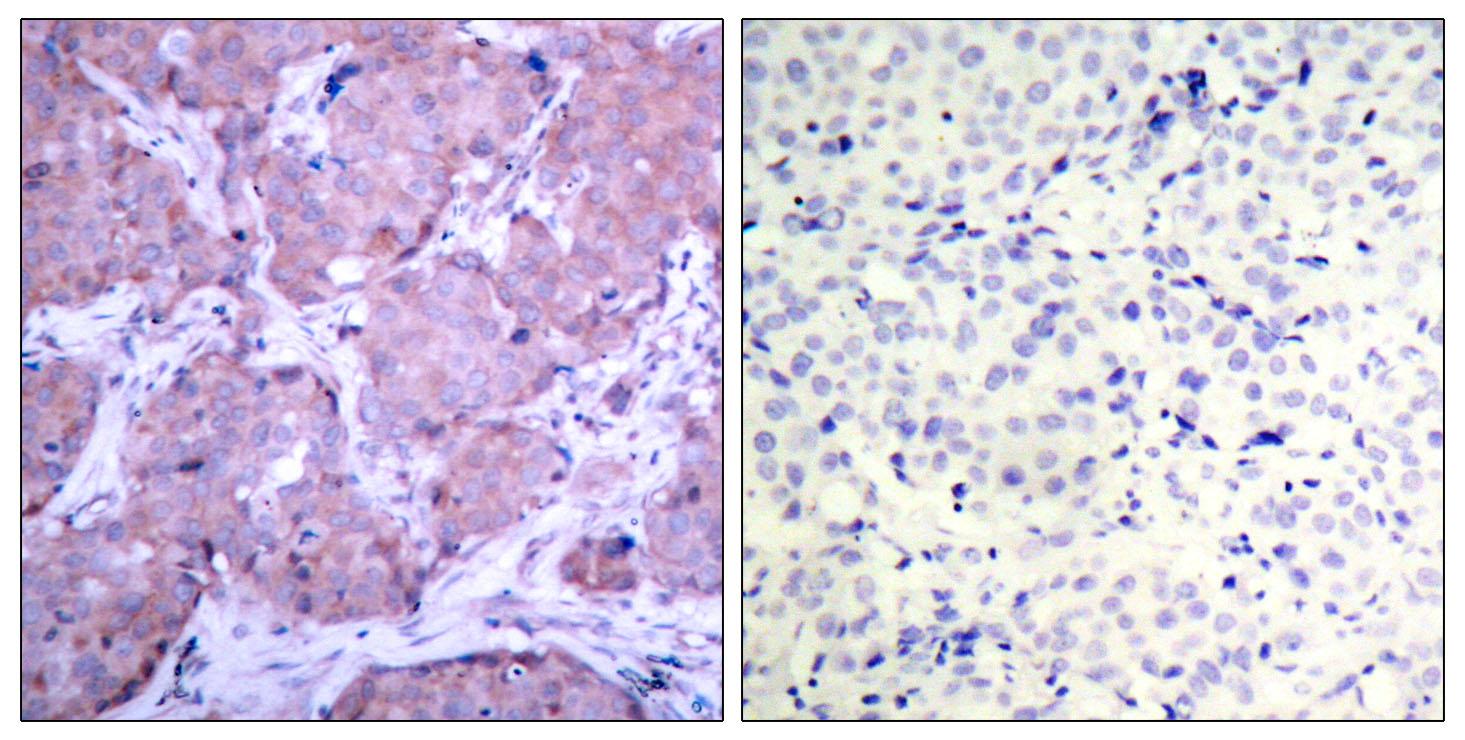
- Immunohistochemistry analysis of paraffin-embedded human breast carcinoma tissue, using ENAH Antibody. The picture on the right is blocked with the synthesized peptide.

Related Products
- PTEN (Phospho-Ser380) Antibody Datasheet
Catalog Number:
E011009-1Amount:
50μg/50μlReactivity:
Human, Mouse, RatApplications:
IHC: 1:50~1:100Swiss-Prot No.:
P60484Price:
145$
- PTEN (Phospho-Ser380) Antibody Datasheet
Catalog Number:
E011009-2Amount:
100μg/100μlReactivity:
Human, Mouse, RatApplications:
IHC: 1:50~1:100Swiss-Prot No.:
P60484Price:
225$
- NFκB-p65 (Phospho-Ser468) Antibody Datasheet
Catalog Number:
E011013-1Amount:
50μg/50μlReactivity:
Human, Mouse, RatApplications:
WB: 1:500~1:1000 IF:1:100~1:200Swiss-Prot No.:
Q04206Price:
145$
- NFκB-p65 (Phospho-Ser468) Antibody Datasheet
Catalog Number:
E011013-2Amount:
100μg/100μlReactivity:
Human, Mouse, RatApplications:
WB: 1:500~1:1000 IF:1:100~1:200Swiss-Prot No.:
Q04206Price:
225$

- Rel (Phospho-Ser503) Antibody Datasheet
Catalog Number:
E011020-1Amount:
50μg/50μlReactivity:
HumanApplications:
IF:1:100~1:200Swiss-Prot No.:
Q04864Price:
145$

Catalog Number
- Amount:100ul
- Price:225$

Contact us
Categories by research area
Categories by product type
- Antibodies
- Tag antibodies
- Internal control antibodies
- Pathological (Immunohistochemistry, IHC) antibodies
- Cell Signal Transduction Research Antibodies
- Secondary Antibody
- Antibody Sampler Kits
- Recombinant Proteins
- Fluorescence Reagents
- Signal Inhibitors and Activators
- Transfection Reagent
- Cell biology kits