World supplier of antibodies, antigens and kits since 2007

Other Products
DNA Ligase III Polyclonal Antibody
Human;Rat;Mouse;
WB;ELISA
Polyclonal, Rabbit,IgG
Price on request
Quantity
Ship worldwide. Contact order@enogene.com for ordering and bulk pricing or contact your local distributor.
Gene NameLIG3
Product Information
Protein NameDNA ligase 3
Human Gene Id3980
Human Swiss Prot NoP49916
Mouse Swiss Prot NoP97386
SpecificityDNA Ligase III Polyclonal Antibody detects endogenous levels of DNA Ligase III protein.
FormulationLiquid in PBS containing 50% glycerol, 0.5% BSA and 0.02% sodium azide.
Concentration1 mg/ml
Storage Stability-20°C/1 year
Other NameLIG3; DNA ligase 3; DNA ligase III; Polydeoxyribonucleotide synthase [ATP] 3
Molecular Weight102691Da
Observed Band(KD)100
Functioncatalytic activity:ATP + (deoxyribonucleotide)(n) + (deoxyribonucleotide)(m) = AMP + diphosphate + (deoxyribonucleotide)(n+m).,cofactor:Magnesium.,function:Interacts with DNA-repair protein XRCC1 and can correct defective DNA strand-break repair and sister chromatid exchange following treatment with ionizing radiation and alkylating agents.,online information:DNA ligase entry,similarity:Belongs to the ATP-dependent DNA ligase family.,similarity:Contains 1 BRCT domain.,similarity:Contains 1 PARP-type zinc finger.,tissue specificity:Testis, thymus, prostate and heart.,
Subcellular Location[Isoform 1]: Mitochondrion . Contains an N-terminal mitochondrial transit peptide. .; [Isoform 2]: Mitochondrion . Contains an N-terminal mitochondrial transit peptide. .; [Isoform 3]: Nucleus . Lacks the N-terminal mitochondrial transit peptide. .; [Isoform 4]: Nucleus . Lacks the N-terminal mitochondrial transit peptide. .
ExpressionTestis, thymus, prostate and heart.
ImmunogenSynthesized peptide derived from DNA Ligase III . at AA range: 110-190
DilutionWestern Blot: 1/500 - 1/2000. ELISA: 1/10000. Not yet tested in other applications.
PurificationThe antibody was affinity-purified from rabbit antiserum by affinity-chromatography using epitope-specific immunogen.
BackgroundThis gene is a member of the DNA ligase family. Each member of this family encodes a protein that catalyzes the joining of DNA ends but they each have a distinct role in DNA metabolism. The protein encoded by this gene is involved in excision repair and is located in both the mitochondria and nucleus, with translation initiation from the upstream start codon allowing for transport to the mitochondria and translation initiation from a downstream start codon allowing for transport to the nucleus. Additionally, alternate transcriptional splice variants, encoding different isoforms, have been characterized. [provided by RefSeq, Jul 2008],
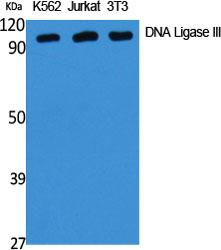
Western Blot analysis of various cells using DNA Ligase Polyclonal Antibody diluted at 1:1000 cells extracted by Minute Cytoplasmic and Fractionation kit.
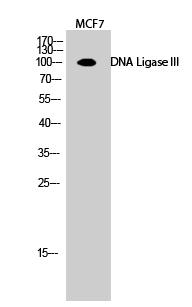
III Western Blot analysis of MCF7 cells using nucleus DNA Ligase III Polyclonal Antibody diluted at Nuclear 1:1000 cells nucleus extracted by Minute Cytoplasmic and Nuclear Fractionation kit.
Conjugated Antibody
This product is also available conjugated. Format: E20-713865-Conjugate. Price: $485 / Size: 100μl.
E20-713865-FITC$485 / 100μlE20-713865-Biotin$485 / 100μlE20-713865-HRP$485 / 100μlE20-713865-AP$485 / 100μlE20-713865-AF350$485 / 100μlE20-713865-AF405M$485 / 100μlE20-713865-AF488$485 / 100μlE20-713865-AF514$485 / 100μlE20-713865-AF532$485 / 100μlE20-713865-AF555$485 / 100μlE20-713865-AF568$485 / 100μlE20-713865-AF405S$485 / 100μlE20-713865-AF405L$485 / 100μlE20-713865-AF546$485 / 100μlE20-713865-AF594$485 / 100μlE20-713865-AF610$485 / 100μlE20-713865-AF635$485 / 100μlE20-713865-AF647$485 / 100μlE20-713865-AF680$485 / 100μlE20-713865-AF700$485 / 100μlE20-713865-AF750$485 / 100μlE20-713865-AF790$485 / 100μlE20-713865-APC$485 / 100μlE20-713865-PE$485 / 100μlE20-713865-Cy3$485 / 100μlE20-713865-Cy5$485 / 100μlE20-713865-Cy5.5$485 / 100μlE20-713865-Cy7$485 / 100μlE20-713865-PE-Cy5$485 / 100μl
Contact order@enogene.com to order conjugated formats. Magnetic Beads (1-30μm) conjugation is also available.


Categories by research area
Categories by product type
- Antibodies
- Primary Antibodies
- Tag antibodies
- Internal control antibodies
- Pathological (Immunohistochemistry, IHC) antibodies
- Cell Signal Transduction Research Antibodies
- Secondary Antibody
- Antibody Sampler Kits
- ELISA Kits
- Recombinant Proteins
- Fluorescence Reagents
- Signal Inhibitors and Activators
- Transfection Reagent
- Cell biology kits
- Overexpression Cell Lines
- Cell Lysates
- Purification Resins
- 2019-nCoV & Monkeypox