World supplier of antibodies, antigens and kits since 2007

Other Products
DIO3 Polyclonal Antibody
Human;Rat;Mouse;
WB;ELISA
Polyclonal, Rabbit,IgG
Price on request
Quantity
Ship worldwide. Contact order@enogene.com for ordering and bulk pricing or contact your local distributor.
Gene NameDIO3
Product Information
Protein NameType III iodothyronine deiodinase
Human Gene Id1735
Human Swiss Prot NoP55073
Mouse Gene Id107585
Mouse Swiss Prot NoQ91ZI8
Rat Gene Id29475
Rat Swiss Prot NoP49897
SpecificityDIO3 Polyclonal Antibody detects endogenous levels of DIO3 protein.
FormulationLiquid in PBS containing 50% glycerol, 0.5% BSA and 0.02% sodium azide.
Concentration1 mg/ml
Storage Stability-20°C/1 year
Other NameDIO3; ITDI3; TXDI3; Type III iodothyronine deiodinase; 5DIII; DIOIII; Type 3 DI; Type-III 5'-deiodinase
Molecular Weight31451Da
Observed Band(KD)31
Functioncatalytic activity:3,3',5'-triiodo-L-thyronine + iodide + A + H(+) = L-thyroxine + AH(2).,function:Responsible for the deiodination of T4 (3,5,3',5'-tetraiodothyronine) into RT3 (3,3',5'-triiodothyronine) and of T3 (3,5,3'-triiodothyronine) into T2 (3,3'-diiodothyronine). RT3 and T2 are inactive metabolites. May play a role in preventing premature exposure of developing fetal tissues to adult levels of thyroid hormones. Can regulate circulating fetal thyroid hormone concentrations throughout gestation. Essential role for regulation of thyroid hormone inactivation during embryological development.,function:Responsible for the deiodination of T4 (3,5,3',5'-tetraiodothyronine).,similarity:Belongs to the iodothyronine deiodinase family.,tissue specificity:Expressed in placenta and several fetal tissues.,
Subcellular LocationCell membrane ; Single-pass type II membrane protein . Endosome membrane ; Single-pass type II membrane protein .
ExpressionExpressed in placenta and several fetal tissues.
ImmunogenThe antiserum was produced against synthesized peptide derived from human DIO3. AA range:17-66
DilutionWestern Blot: 1/500 - 1/2000. ELISA: 1/20000. Not yet tested in other applications.
PurificationThe antibody was affinity-purified from rabbit antiserum by affinity-chromatography using epitope-specific immunogen.
BackgroundThe protein encoded by this intronless gene belongs to the iodothyronine deiodinase family. It catalyzes the inactivation of thyroid hormone by inner ring deiodination of the prohormone thyroxine (T4) and the bioactive hormone 3,3',5-triiodothyronine (T3) to inactive metabolites, 3,3',5'-triiodothyronine (RT3) and 3,3'-diiodothyronine (T2), respectively. This enzyme is highly expressed in pregnant uterus, placenta, fetal and neonatal tissues, and thought to prevent premature exposure of developing fetal tissues to adult levels of thyroid hormones. It regulates circulating fetal thyroid hormone concentrations, and thus plays a critical role in mammalian development. Knockout mice lacking this gene exhibit abnormalities related to development and reproduction, and increased activity of this enzyme in infants with hemangiomas causes severe hypothyroidism. This protei
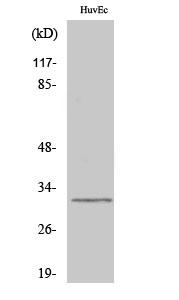
Western Blot analysis of HUVEC cells using DIO3 Polyclonal Antibody. using
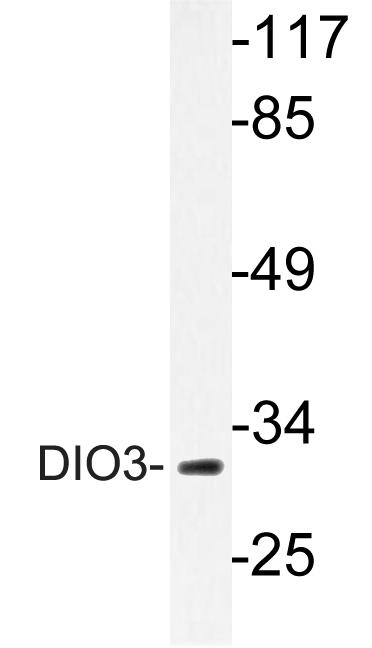
Western blot analysis of lysate from HUVEC cells, DIO3 antibody.
Conjugated Antibody
This product is also available conjugated. Format: E20-713852-Conjugate. Price: $485 / Size: 100μl.
E20-713852-FITC$485 / 100μlE20-713852-Biotin$485 / 100μlE20-713852-HRP$485 / 100μlE20-713852-AP$485 / 100μlE20-713852-AF350$485 / 100μlE20-713852-AF405M$485 / 100μlE20-713852-AF488$485 / 100μlE20-713852-AF514$485 / 100μlE20-713852-AF532$485 / 100μlE20-713852-AF555$485 / 100μlE20-713852-AF568$485 / 100μlE20-713852-AF405S$485 / 100μlE20-713852-AF405L$485 / 100μlE20-713852-AF546$485 / 100μlE20-713852-AF594$485 / 100μlE20-713852-AF610$485 / 100μlE20-713852-AF635$485 / 100μlE20-713852-AF647$485 / 100μlE20-713852-AF680$485 / 100μlE20-713852-AF700$485 / 100μlE20-713852-AF750$485 / 100μlE20-713852-AF790$485 / 100μlE20-713852-APC$485 / 100μlE20-713852-PE$485 / 100μlE20-713852-Cy3$485 / 100μlE20-713852-Cy5$485 / 100μlE20-713852-Cy5.5$485 / 100μlE20-713852-Cy7$485 / 100μlE20-713852-PE-Cy5$485 / 100μl
Contact order@enogene.com to order conjugated formats. Magnetic Beads (1-30μm) conjugation is also available.


Categories by research area
Categories by product type
- Antibodies
- Primary Antibodies
- Tag antibodies
- Internal control antibodies
- Pathological (Immunohistochemistry, IHC) antibodies
- Cell Signal Transduction Research Antibodies
- Secondary Antibody
- Antibody Sampler Kits
- ELISA Kits
- Recombinant Proteins
- Fluorescence Reagents
- Signal Inhibitors and Activators
- Transfection Reagent
- Cell biology kits
- Overexpression Cell Lines
- Cell Lysates
- Purification Resins
- 2019-nCoV & Monkeypox