World supplier of antibodies, antigens and kits since 2007

Other Products
DGK-δ Polyclonal Antibody
Human;Rat;Mouse;
WB;IF/ICC;ELISA
Polyclonal, Rabbit,IgG
Price on request
Quantity
Ship worldwide. Contact order@enogene.com for ordering and bulk pricing or contact your local distributor.
Gene NameDGKD
Product Information
Protein NameDiacylglycerol kinase delta
Human Gene Id8527
Human Swiss Prot NoQ16760
SpecificityDGK-δ Polyclonal Antibody detects endogenous levels of DGK-δ protein.
FormulationLiquid in PBS containing 50% glycerol, 0.5% BSA and 0.02% sodium azide.
Concentration1 mg/ml
Storage Stability-20°C/1 year
Other NameDGKD; KIAA0145; Diacylglycerol kinase delta; DAG kinase delta; 130 kDa diacylglycerol kinase; Diglyceride kinase delta; DGK-delta
Molecular Weight134525Da
Observed Band(KD)135
Functioncatalytic activity:ATP + 1,2-diacylglycerol = ADP + 1,2-diacyl-sn-glycerol 3-phosphate.,enzyme regulation:Partially inhibited by phosphatidylserine.,function:May function as signaling molecule. Isoform 2 may be involved in cell growth and tumorigenesis.,PTM:Isoform 1 H domain is phosphorylated.,similarity:Belongs to the eukaryotic diacylglycerol kinase family.,similarity:Contains 1 DAGKc domain.,similarity:Contains 1 PH domain.,similarity:Contains 1 SAM (sterile alpha motif) domain.,similarity:Contains 2 phorbol-ester/DAG-type zinc fingers.,subunit:The two isoforms are able to form homo- and hetero-oligomer structures (at least tetramers).,tissue specificity:Isoform 2 is ubiquitously expressed also in tumor tissues. Isoform 1 is expressed in ovary, spleen and some tumor-derived cells.,
Subcellular LocationMembrane, clathrin-coated pit . Cytoplasm .; [Isoform 1]: Cell membrane ; Peripheral membrane protein . Cytoplasm . Isoform 1 translocation from cytoplasm to the plasma membrane is induced by phorbol esters (PubMed:12200442). Phorbol esters induce the conversion into the monomeric form which can translocate to the plasma membrane (PubMed:12084710). .
Expression[Isoform 2]: Widely expressed. ; [Isoform 1]: Only detected in ovary, and to a lesser extent in spleen.
ImmunogenThe antiserum was produced against synthesized peptide derived from human DGKD. AA range:41-90
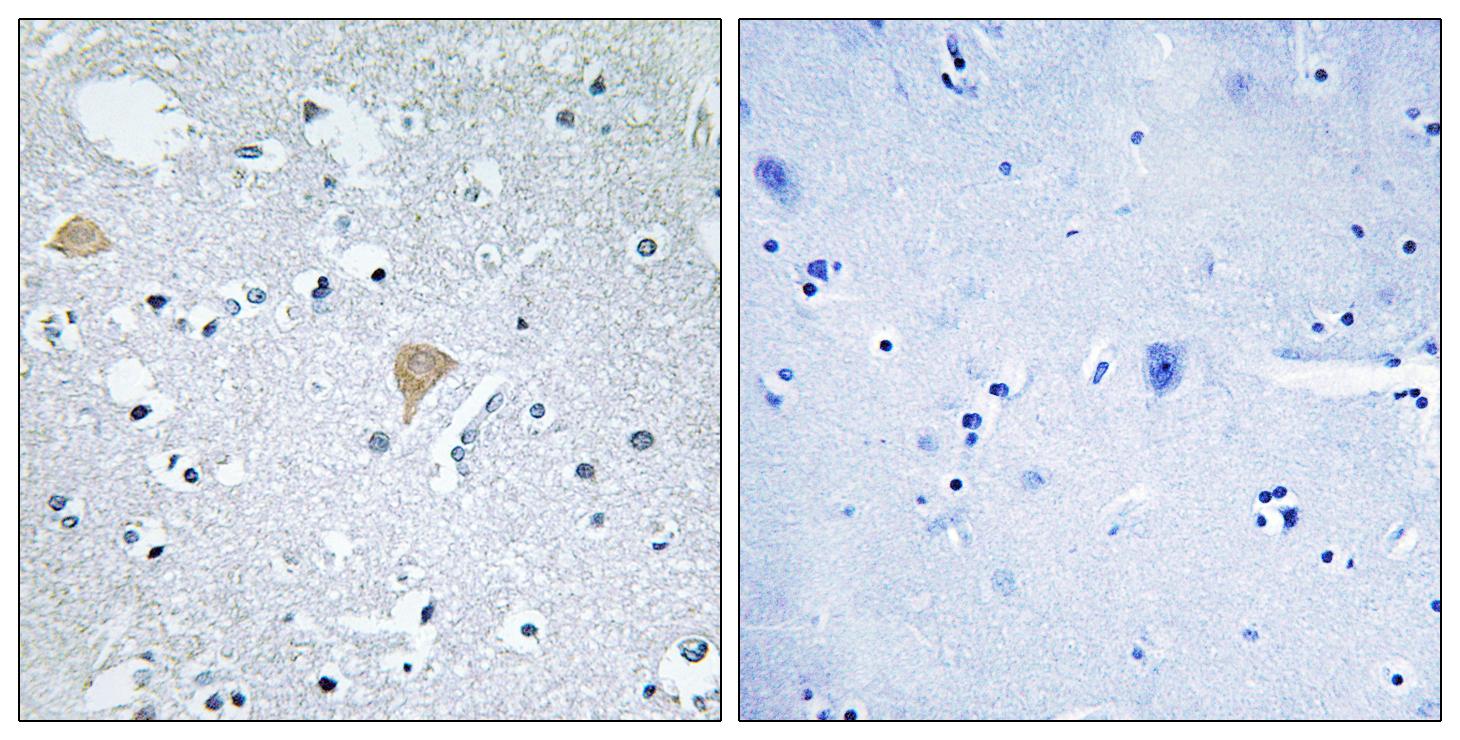
DilutionWestern Blot: 1/500 - 1/2000. Immunohistochemistry: 1/100 - 1/300. Immunofluorescence: 1/200 - 1/1000. ELISA: 1/20000. Not yet tested in other applications.
PurificationThe antibody was affinity-purified from rabbit antiserum by affinity-chromatography using epitope-specific immunogen.
BackgroundThis gene encodes a cytoplasmic enzyme that phosphorylates diacylglycerol to produce phosphatidic acid. Diacylglycerol and phosphatidic acid are two lipids that act as second messengers in signaling cascades. Their cellular concentrations are regulated by the encoded protein, and so it is thought to play an important role in cellular signal transduction. Alternative splicing results in two transcript variants encoding different isoforms. [provided by RefSeq, Jul 2008],
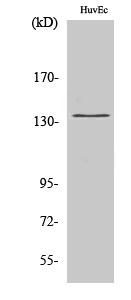
Western Blot analysis of various cells using DGK-δ Polyclonal Antibody. with
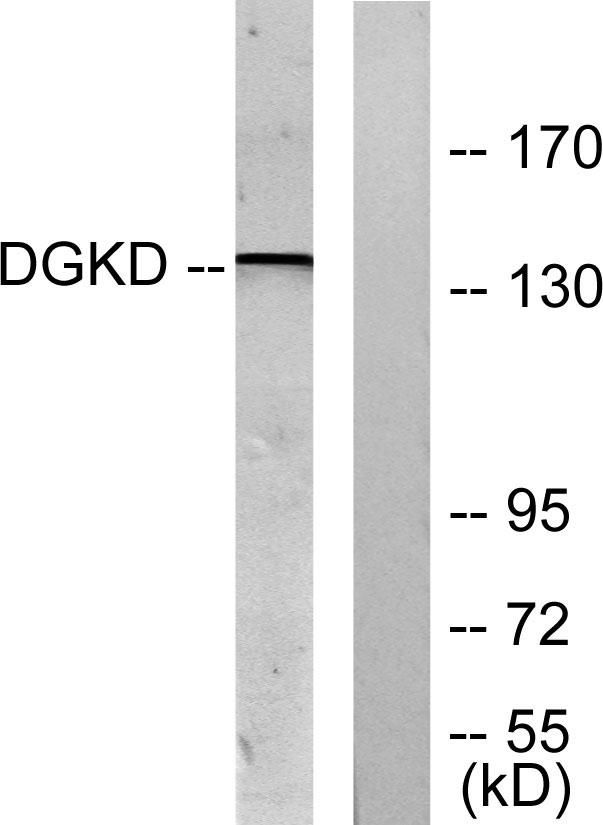
Western blot analysis of lysates from HUVEC cells, using DGKD Antibody. The lane on the right is blocked the synthesized peptide.
Conjugated Antibody
This product is also available conjugated. Format: E20-713833-Conjugate. Price: $485 / Size: 100μl.
E20-713833-FITC$485 / 100μlE20-713833-Biotin$485 / 100μlE20-713833-HRP$485 / 100μlE20-713833-AP$485 / 100μlE20-713833-AF350$485 / 100μlE20-713833-AF405M$485 / 100μlE20-713833-AF488$485 / 100μlE20-713833-AF514$485 / 100μlE20-713833-AF532$485 / 100μlE20-713833-AF555$485 / 100μlE20-713833-AF568$485 / 100μlE20-713833-AF405S$485 / 100μlE20-713833-AF405L$485 / 100μlE20-713833-AF546$485 / 100μlE20-713833-AF594$485 / 100μlE20-713833-AF610$485 / 100μlE20-713833-AF635$485 / 100μlE20-713833-AF647$485 / 100μlE20-713833-AF680$485 / 100μlE20-713833-AF700$485 / 100μlE20-713833-AF750$485 / 100μlE20-713833-AF790$485 / 100μlE20-713833-APC$485 / 100μlE20-713833-PE$485 / 100μlE20-713833-Cy3$485 / 100μlE20-713833-Cy5$485 / 100μlE20-713833-Cy5.5$485 / 100μlE20-713833-Cy7$485 / 100μlE20-713833-PE-Cy5$485 / 100μl
Contact order@enogene.com to order conjugated formats. Magnetic Beads (1-30μm) conjugation is also available.


Categories by research area
Categories by product type
- Antibodies
- Primary Antibodies
- Tag antibodies
- Internal control antibodies
- Pathological (Immunohistochemistry, IHC) antibodies
- Cell Signal Transduction Research Antibodies
- Secondary Antibody
- Antibody Sampler Kits
- ELISA Kits
- Recombinant Proteins
- Fluorescence Reagents
- Signal Inhibitors and Activators
- Transfection Reagent
- Cell biology kits
- Overexpression Cell Lines
- Cell Lysates
- Purification Resins
- 2019-nCoV & Monkeypox