
You are here: EnoGene Home > Products > Cell Signal Transduction Research Antibodies > CD284 Polyclonal Antibody
CD284 Polyclonal Antibody
Datasheet
Catalog Number:
E20-70744Amount:
100ulMolecular Weight:
95680DaApplications:
IF/ICC;WB;IHC-p;ELISAReactivity:
Human;Mouse;Purification:
The antibody was affinity-purified from rabbit antiserum by affinity-chromatography using epitope-specific immunogen.Immunogen:
The antiserum was produced against synthesized peptide derived from human CD284. AA range:392-441Source:
Polyclonal, Rabbit,IgG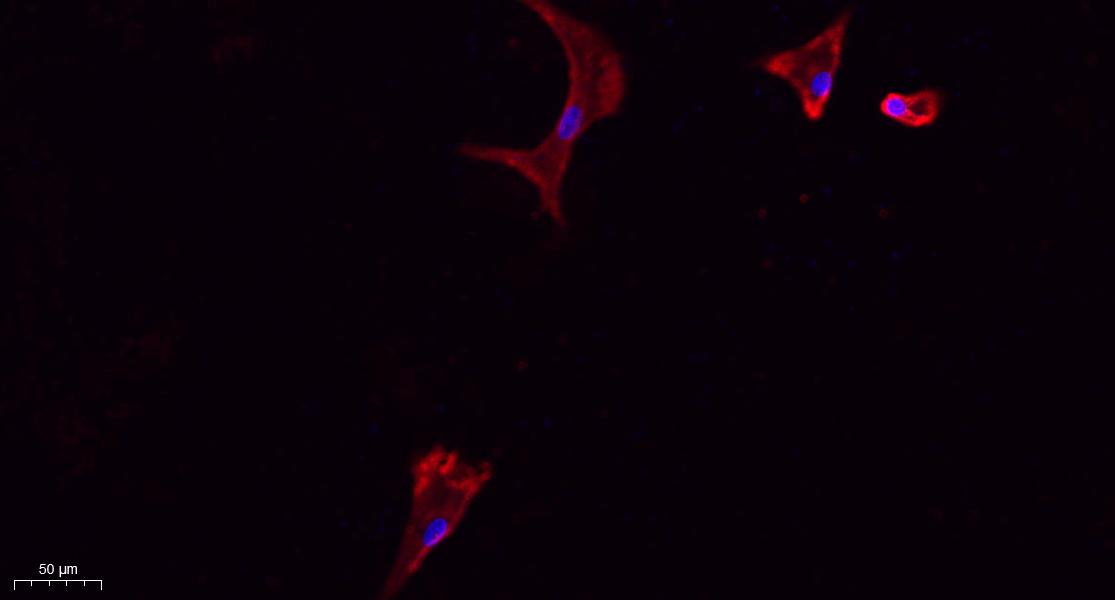
- Immunofluorescence analysis of A549. 1,primary Antibody(red) was diluted at 1:200(4°C overnight). 2, Goat Anti Rabbit IgG (H&L) - Alexa Fluor 594 Secondary antibody was diluted at 1:1000(room temperature, 50min).3, Picture B: DAPI(blue) 10min.
Gene Name:
TLR4Dilution:
IF: 1:50-200 Western Blot: 1/500 - 1/2000. Immunohistochemistry: 1/100 - 1/300. ELISA: 1/40000. Not yet tested in other applications.Protein Name:
Toll-like receptor 4Human Gene Id:
7099Human Swiss Prot No:
O00206Mouse Gene Id:
21898Mouse Swiss Prot No:
Q9QUK6Specificity:
CD284 Polyclonal Antibody detects endogenous levels of CD284 protein.Formulation:
Liquid in PBS containing 50% glycerol, 0.5% BSA and 0.02% sodium azide.Concentration:
1 mg/mlStorage Stability:
-20°C/1 yearOther Name:
TLR4; Toll-like receptor 4; hToll; CD antigen CD284Observed Band(KD):
95Background:
The protein encoded by this gene is a member of the Toll-like receptor (TLR) family which plays a fundamental role in pathogen recognition and activation of innate immunity. TLRs are highly conserved from Drosophila to humans and share structural and functional similarities. They recognize pathogen-associated molecular patterns that are expressed on infectious agents, and mediate the production of cytokines necessary for the development of effective immunity. The various TLRs exhibit different patterns of expression. This receptor has been implicated in signal transduction events induced by lipopolysaccharide (LPS) found in most gram-negative bacteria. Mutations in this gene have been associated with differences in LPS responsiveness. Multiple transcript variants encoding different isoforms have been found for this gene. [provided by RefSeq, Jan 2012],Function:
disease:Genetic variation in TLR4 is associated with age-related macular degeneration type 10 (ARMD10) [MIM:611488]. ARMD is a multifactorial eye disease and the most common cause of irreversible vision loss in the developed world. In most patients, the disease is manifest as ophthalmoscopically visible yellowish accumulations of protein and lipid that lie beneath the retinal pigment epithelium and within an elastin-containing structure known as Bruch membrane.,domain:The TIR domain mediates interaction with NOX4.,function:Cooperates with LY96 and CD14 to mediate the innate immune response to bacterial lipopolysaccharide (LPS). Acts via MYD88, TIRAP and TRAF6, leading to NF-kappa-B activation, cytokine secretion and the inflammatory response.,polymorphism:Allele TLR4*B (Gly-299, Ile-399) is associated with a blunted response to inhaled LPS.,PTM:N-glycosylated. Glycosylation of Asn-526 anSubcellular Location:
Cell membrane ; Single-pass type I membrane protein . Early endosome . Cell projection, ruffle . Upon complex formation with CD36 and TLR6, internalized through dynamin-dependent endocytosis (PubMed:20037584). Colocalizes with RFTN1 at cell membrane and then together with RFTN1 moves to endosomes, upon lipopolysaccharide stimulation. .Expression:
Highly expressed in placenta, spleen and peripheral blood leukocytes (PubMed:9435236, PubMed:9237759). Detected in monocytes, macrophages, dendritic cells and several types of T-cells (PubMed:9237759, PubMed:27022195).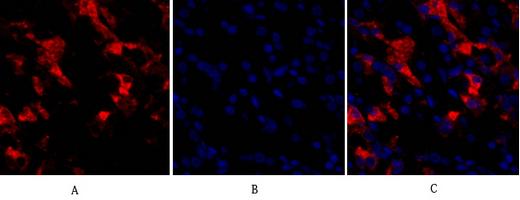
- Immunofluorescence analysis of human-stomach tissue. 1,CD284 Polyclonal Antibody(red) was diluted at 1:200(4°C,overnight). 2, Cy3 labled Secondary antibody was diluted at 1:300(room temperature, 50min).3, Picture B: DAPI(blue) 10min. Picture A:Target. Picture B: DAPI. Picture C: merge of A+B
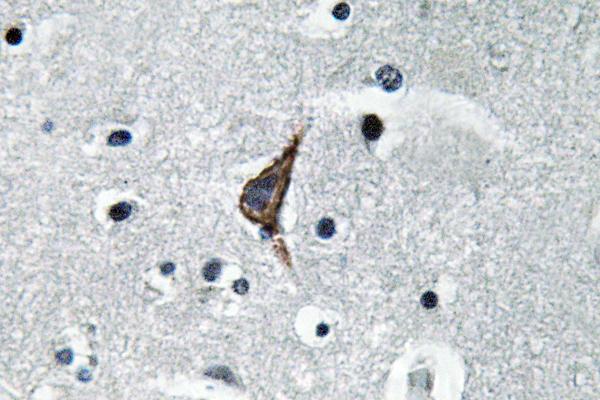 Immunohistochemistry analysis of TLR4 Western Blot analysis of various antibody in paraffin-embedded human brain Polyclonal Antibody diluted tissue.
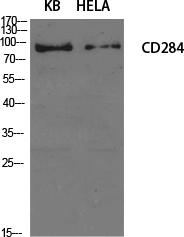 TLR4 Western Blot analysis of various cells using CD284 brain Polyclonal Antibody diluted at 1:1000.

Related Products

- PTEN (Phospho-Ser380) Antibody Datasheet
Catalog Number:
E011009-1Amount:
50μg/50μlReactivity:
Human, Mouse, RatApplications:
IHC: 1:50~1:100Swiss-Prot No.:
P60484Price:
145$

- PTEN (Phospho-Ser380) Antibody Datasheet
Catalog Number:
E011009-2Amount:
100μg/100μlReactivity:
Human, Mouse, RatApplications:
IHC: 1:50~1:100Swiss-Prot No.:
P60484Price:
225$

- NFκB-p65 (Phospho-Ser468) Antibody Datasheet
Catalog Number:
E011013-1Amount:
50μg/50μlReactivity:
Human, Mouse, RatApplications:
WB: 1:500~1:1000 IF:1:100~1:200Swiss-Prot No.:
Q04206Price:
145$

- NFκB-p65 (Phospho-Ser468) Antibody Datasheet
Catalog Number:
E011013-2Amount:
100μg/100μlReactivity:
Human, Mouse, RatApplications:
WB: 1:500~1:1000 IF:1:100~1:200Swiss-Prot No.:
Q04206Price:
225$

- Rel (Phospho-Ser503) Antibody Datasheet
Catalog Number:
E011020-1Amount:
50μg/50μlReactivity:
HumanApplications:
IF:1:100~1:200Swiss-Prot No.:
Q04864Price:
145$

Catalog Number
- Amount:100ul
- Price:225$

Contact us
Categories by research area
Categories by product type
- Antibodies
- Tag antibodies
- Internal control antibodies
- Pathological (Immunohistochemistry, IHC) antibodies
- Cell Signal Transduction Research Antibodies
- Secondary Antibody
- Antibody Sampler Kits
- Recombinant Proteins
- Fluorescence Reagents
- Signal Inhibitors and Activators
- Transfection Reagent
- Cell biology kits