World supplier of antibodies, antigens and kits since 2007

Cell Signal Transduction Research Antibodies
ADAR1 Polyclonal Antibody
Polyclonal, Rabbit
$225/ 100ul
QuantityTotal: $225
Ship worldwide. Contact order@enogene.com for ordering and bulk pricing or contact your local distributor.
Product Information
Molecular Weight135995 Da
Protein NameDouble-stranded RNA-specific adenosine deaminase
Human Gene Id103
Human Swiss Prot NoP55265
Mouse Gene Id56417
Mouse Swiss Prot NoQ99MU3
Rat Gene Id81635
Rat Swiss Prot NoP55266
SpecificityADAR1 Polyclonal Antibody detects endogenous levels of ADAR1 protein.
FormulationLiquid in PBS containing 50% glycerol, 0.5% BSA and 0.02% sodium azide.
Concentration1 mg/ml
Storage Stability-20°C/1 year
Other NameADAR; ADAR1; DSRAD; G1P1; IFI4; Double-stranded RNA-specific adenosine deaminase; DRADA; 136 kDa double-stranded RNA-binding protein; p136; Interferon-inducible protein 4; IFI-4; K88DSRBP
Observed Band(KD)135
Functioncaution:The N-terminus of isoform 4 has been derived from EST and genomic sequences.,disease:Defects in ADAR are a cause of dyschromatosis symmetrical hereditaria (DSH) [MIM:127400]; also known as reticulate acropigmentation of Dohi. DSH is a pigmentary genodermatosis of autosomal dominant inheritance characterized by a mixture of hyperpigmented and hypopigmented macules distributed on the dorsal parts of the hands and feet.,function:Converts multiple adenosines to inosines and creates I/U mismatched base pairs in double-helical RNA substrates without apparent sequence specificity. Has been found to modify more frequently adenosines in AU-rich regions, probably due to the relative ease of melting A/U base pairs as compared to G/C pairs. Functions to modify viral RNA genomes and may be responsible for hypermutation of certain negative-stranded viruses. Edits the messenger RNAs for glutama
Subcellular Locationnucleus,nucleoplasm,nucleolus,cytoplasm,membrane,supraspliceosomal complex,
ExpressionAmygdala,Aorta endothelial cell,Cervix carcinoma,Epithelium,Fetal kidney,Ki
PurificationThe antibody was affinity-purified from rabbit antiserum by affinity-chromatography using epitope-specific immunogen.
ImmunogenThe antiserum was produced against synthesized peptide derived from human ADAR1. AA range:1172-1221
Gene NameADAR
DilutionWB 1:500-2000 Immunohistochemistry: 1/100 - 1/300. ELISA: 1/20000. Not yet tested in other applications.
Backgroundadenosine deaminase, RNA specific(ADAR) Homo sapiens This gene encodes the enzyme responsible for RNA editing by site-specific deamination of adenosines. This enzyme destabilizes double-stranded RNA through conversion of adenosine to inosine. Mutations in this gene have been associated with dyschromatosis symmetrica hereditaria. Alternative splicing results in multiple transcript variants. [provided by RefSeq, Jul 2010],
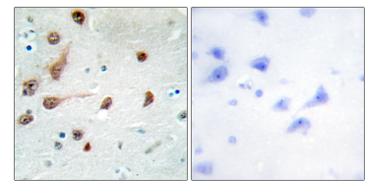
Immunohistochemistry analysis of paraffin-embedded human brain tissue,using ADAR1 Antibody. The picture on the right is blocked with the synthesized peptide.
Conjugated Antibody
This product is also available conjugated. Format: E20-70118-Conjugate. Price: $485 / Size: 100μl.
E20-70118-FITC$485 / 100μlE20-70118-Biotin$485 / 100μlE20-70118-HRP$485 / 100μlE20-70118-AP$485 / 100μlE20-70118-AF350$485 / 100μlE20-70118-AF405M$485 / 100μlE20-70118-AF488$485 / 100μlE20-70118-AF514$485 / 100μlE20-70118-AF532$485 / 100μlE20-70118-AF555$485 / 100μlE20-70118-AF568$485 / 100μlE20-70118-AF405S$485 / 100μlE20-70118-AF405L$485 / 100μlE20-70118-AF546$485 / 100μlE20-70118-AF594$485 / 100μlE20-70118-AF610$485 / 100μlE20-70118-AF635$485 / 100μlE20-70118-AF647$485 / 100μlE20-70118-AF680$485 / 100μlE20-70118-AF700$485 / 100μlE20-70118-AF750$485 / 100μlE20-70118-AF790$485 / 100μlE20-70118-APC$485 / 100μlE20-70118-PE$485 / 100μlE20-70118-Cy3$485 / 100μlE20-70118-Cy5$485 / 100μlE20-70118-Cy5.5$485 / 100μlE20-70118-Cy7$485 / 100μlE20-70118-PE-Cy5$485 / 100μl
Contact order@enogene.com to order conjugated formats. Magnetic Beads (1-30μm) conjugation is also available.




Categories by research area
Categories by product type
- Antibodies
- Tag antibodies
- Internal control antibodies
- Pathological (Immunohistochemistry, IHC) antibodies
- Cell Signal Transduction Research Antibodies
- Secondary Antibody
- Antibody Sampler Kits
- Recombinant Proteins
- Fluorescence Reagents
- Signal Inhibitors and Activators
- Transfection Reagent
- Cell biology kits