
You are here: EnoGene Home > Products > Cell Signal Transduction Research Antibodies > PKC δ (phospho Tyr313) Polyclonal Antibody
PKC δ (phospho Tyr313) Polyclonal Antibody
Datasheet
Catalog Number:
E20-60704Amount:
100ulPrice:
225$Purification:
The antibody was affinity-purified from rabbit antiserum by affinity-chromatography using epitope-specific immunogen.Immunogen:
The antiserum was produced against synthesized peptide derived from human PKC delta around the phosphorylation site of Tyr313. AA range:279-328Source:
Polyclonal, RabbitGene Name:
PRKCDDilution:
Western Blot: 1/500 - 1/2000. Immunohistochemistry: 1/100 - 1/300. Immunofluorescence: 1/200 - 1/1000. ELISA: 1/10000. Not yet tested in other applications.
- Enzyme-Linked Immunosorbent Assay (Phospho-ELISA) for Immunogen Phosphopeptide (Phospho-left) and Non-Phosphopeptide (Phospho-right), using PKC delta (Phospho-Tyr313) Antibody
Background:
protein kinase C delta(PRKCD) Homo sapiens Protein kinase C (PKC) is a family of serine- and threonine-specific protein kinases that can be activated by calcium and the second messenger diacylglycerol. PKC family members phosphorylate a wide variety of protein targets and are known to be involved in diverse cellular signaling pathways. PKC family members also serve as major receptors for phorbol esters, a class of tumor promoters. Each member of the PKC family has a specific expression profile and is believed to play distinct roles in cells. The protein encoded by this gene is one of the PKC family members. Studies both in human and mice demonstrate that this kinase is involved in B cell signaling and in the regulation of growth, apoptosis, and differentiation of a variety of cell types. Alternatively spliced transcript variants encoding the same protein have been observed. [provided by RefSeq, Jul 2008],Protein Name:
Protein kinase C delta typeHuman Gene Id:
5580Human Swiss Prot No:
Q05655Mouse Gene Id:
18753Mouse Swiss Prot No:
P28867Rat Gene Id:
170538Rat Swiss Prot No:
P09215Specificity:
Phospho-PKC δ (Y313) Polyclonal Antibody detects endogenous levels of PKC δ protein only when phosphorylated at Y313.Formulation:
Liquid in PBS containing 50% glycerol, 0.5% BSA and 0.02% sodium azide.Concentration:
1 mg/mlStorage Stability:
-20°C/1 yearOther Name:
PRKCD; Protein kinase C delta type; Tyrosine-protein kinase PRKCD; nPKC-deltaMolecularWeight(Da):
77477Observed Band(KD):
78Function:
catalytic activity:ATP + a protein = ADP + a phosphoprotein.,domain:The C1 domain, containing the phorbol ester/DAG-type region 1 (C1A) and 2 (C1B), is the diacylglycerol sensor.,domain:The C2 domain is a non-calcium binding domain. It binds proteins containing phosphotyrosine in a sequence-specific manner.,enzyme regulation:Three specific sites; Thr-507 (activation loop of the kinase domain), Ser-645 (turn motif) and Ser-664 (hydrophobic region), need to be phosphorylated for its full activation.,function:This is calcium-independent, phospholipid-dependent, serine- and threonine-specific enzyme. PKC is activated by diacylglycerol which in turn phosphorylates a range of cellular proteins. PKC also serves as the receptor for phorbol esters, a class of tumor promoters. May play a role in antigen-dependent control of B-cell function. Phosphorylates MUC1 in the C-terminal and regulates the iSubcellular Location:
intracellular,nucleus,nucleoplasm,cytoplasm,endoplasmic reticulum,cytosol,plasma membrane,cell-cell junction,membrane,nuclear matrix,perinuclear region of cytoplasm,extracellular exosome,Expression:
Epithelium,Hippocampus,Liver,Platelet,Skin,
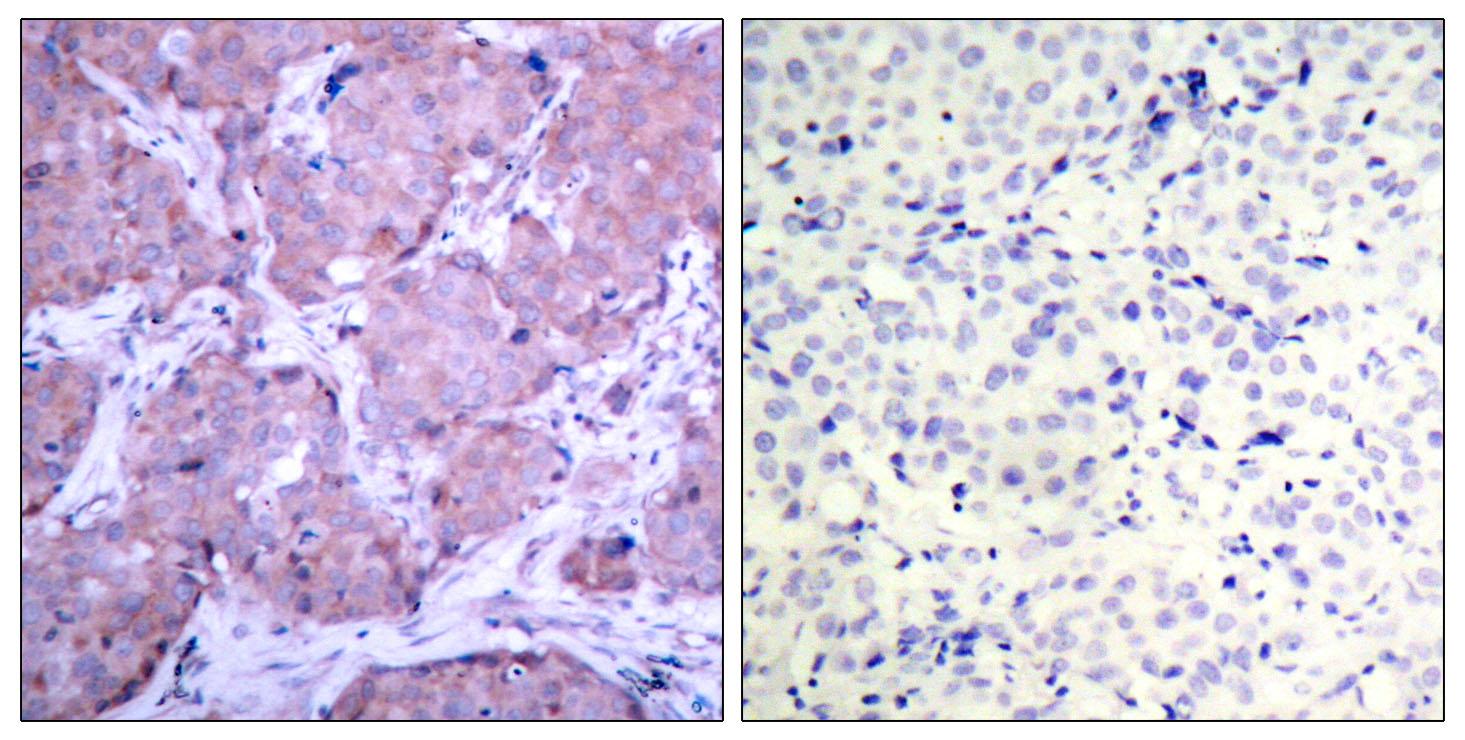
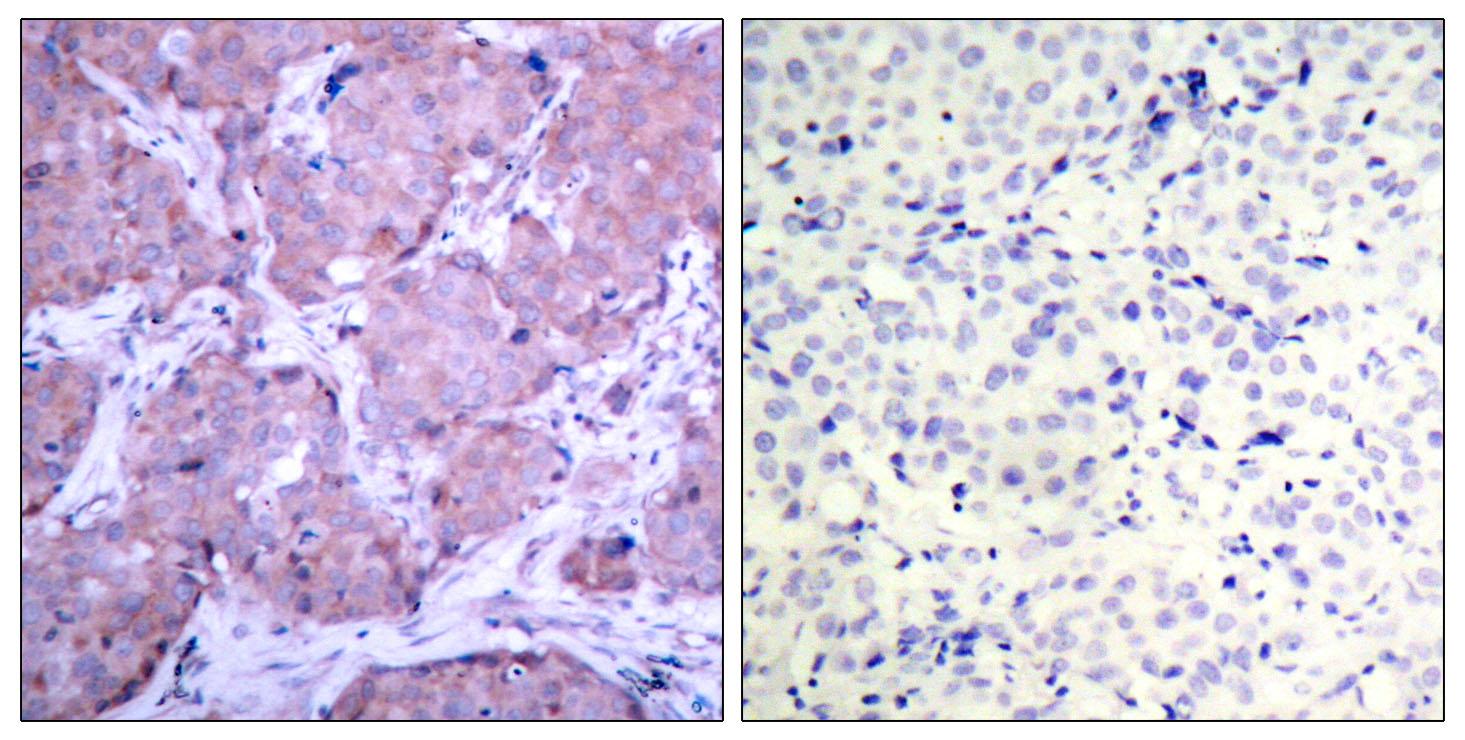
- Immunohistochemistry analysis of paraffin-embedded human breast carcinoma, using PKC delta (Phospho-Tyr313) Antibody. The picture on the right is blocked with the phospho peptide.

Related Products
- PTEN (Phospho-Ser380) Antibody Datasheet
Catalog Number:
E011009-1Amount:
50μg/50μlReactivity:
Human, Mouse, RatApplications:
IHC: 1:50~1:100Swiss-Prot No.:
P60484Price:
145$
- PTEN (Phospho-Ser380) Antibody Datasheet
Catalog Number:
E011009-2Amount:
100μg/100μlReactivity:
Human, Mouse, RatApplications:
IHC: 1:50~1:100Swiss-Prot No.:
P60484Price:
225$
- NFκB-p65 (Phospho-Ser468) Antibody Datasheet
Catalog Number:
E011013-1Amount:
50μg/50μlReactivity:
Human, Mouse, RatApplications:
WB: 1:500~1:1000 IF:1:100~1:200Swiss-Prot No.:
Q04206Price:
145$
- NFκB-p65 (Phospho-Ser468) Antibody Datasheet
Catalog Number:
E011013-2Amount:
100μg/100μlReactivity:
Human, Mouse, RatApplications:
WB: 1:500~1:1000 IF:1:100~1:200Swiss-Prot No.:
Q04206Price:
225$

- Rel (Phospho-Ser503) Antibody Datasheet
Catalog Number:
E011020-1Amount:
50μg/50μlReactivity:
HumanApplications:
IF:1:100~1:200Swiss-Prot No.:
Q04864Price:
145$

Catalog Number
- Amount:100ul
- Price:225$

Contact us
Categories by research area
Categories by product type
- Antibodies
- Tag antibodies
- Internal control antibodies
- Pathological (Immunohistochemistry, IHC) antibodies
- Cell Signal Transduction Research Antibodies
- Secondary Antibody
- Antibody Sampler Kits
- Recombinant Proteins
- Fluorescence Reagents
- Signal Inhibitors and Activators
- Transfection Reagent
- Cell biology kits