World supplier of antibodies, antigens and kits since 2007

Other Products
PKAα/β/γ cat (Phospho Thr197) Rabbit pAb
Human,Rat,Mouse
WB,IHC,IF,ELISA
Price on request
Quantity
Ship worldwide. Contact order@enogene.com for ordering and bulk pricing or contact your local distributor.
Product Information
Host SpeciesRabbit
MW40kD (Observed)
IsotypeIgGRecommended Dilution Ratios: WB 1:500-1:2000
IHC 1:100-1:300
IF 1:200-1:1000
ELISA 1:10000
Not yet tested in other applications.
IHC 1:100-1:300
IF 1:200-1:1000
ELISA 1:10000
Not yet tested in other applications.
FormulationLiquid in PBS containing 50% glycerol, 0.5% BSA and 0.02% sodium azide.
ClonalityPolyclonal
SpecificityPhospho-PKAα/β/γ cat (T197) Polyclonal Antibody detects endogenous levels of PKAα/β/γ cat protein only when phosphorylated at T197.The name of modified sites may be influenced by many factors, such as species (the modified site was not originally found in human samples) and the change of protein sequence (the previous protein sequence is incomplete, and the protein sequence may be prolonged with the development of protein sequencing technology). When naming, we will use the "numbers" in historical reference to keep the sites consistent with the reports. The antibody binds to the following modification sequence (lowercase letters are modification sites):TWtLC
Protein NamecAMP-dependent protein kinase catalytic subunit alpha/betaOrganism:Human,Mouse,Rat
Uniprot IDP17612; P22694; P22612; P27791; P68182;
FunctionCatalytic activity:ATP + a protein = ADP + a phosphoprotein.,enzyme regulation:Activatedby cAMP.,Function:Phosphorylates a large number of substrates in the cytoplasm and the nucleus.,PTM:Asn-3 is partially deaminated to Asp giving rise to 2 major isoelectric variants,called CB and CA respectively.,similarity:Belongs to the protein kinase superfamily.,similarity:Belongs to the protein kinase superfamily. AGC Ser/Thr protein kinase family. cAMP subfamily.,similarity:Contains 1 AGC- kinase C-terminal domain.,similarity:Contains 1 protein kinase domain.,subcellular location: Translocates into the nucleus (monomeric catalytic subunit) (By similarity). The inactive holoenzyme is found in the cytoplasm.,subunit:A number of inactive tetrameric holoenzymes are produced by the combination of homo- or heterodimers of the different regulatory subunits associated with two catalytic subunits. cAMP causes the dissociation of the inactive holoenzyme into a dimer of regulatory subunits bound to four cAMP and two free monomeric catalytic subunits.,tissue specificity:Isoform 2 is sperm specific.
Storage/Stability-15°C to -25°C/1 year(Do not lower than -25°C)
ImmunogenThe antiserum was produced against synthesized peptide derived from human PKA CAT around the phosphorylation site of Thr197. AA range:166-215
Gene NamePRKACA/PRKACB
Gene ID5566; 5567;18747; 18749; 293508;
Cellular localizationCytoplasm. Cell membrane. Nucleus . Mitochondrion . Membrane ; Lipid-anchor .Translocates into the nucleus (monomeric catalytic subunit). The inactive holoenzyme isfound in the cytoplasm. Distributed throughout the cytoplasm in meiotically incompetent oocytes. Associated to mitochondrion as meiotic competence is acquired. Aggregates around the germinal vesicles (GV) at the immature GV stage oocytes (By similarity).Colocalizes with HSF1 in nuclear stress bodies (nSBs) upon heat shock (PubMed:21085490).; [Isoform 2]: Cell projection, cilium, flagellum . Cytoplasmic vesicle, secretory vesicle,acrosome . Expressed in the midpiece region of the sperm flagellum (PubMed:10906071).Colocalizes with MROH2B and TCP11 on the acrosome and tail regions in round spermatids and spermatozoa regardless of the capacitation status of the sperm (By similarity).
Tissue specificity: Isoform 1 is ubiquitous. Isoform 2 is sperm-specific and is enriched in pachytene
spermatocytes but is not detected in round spermatids
Tissue specificity: Isoform 1 is ubiquitous. Isoform 2 is sperm-specific and is enriched in pachytene
spermatocytes but is not detected in round spermatids
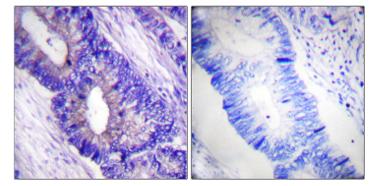
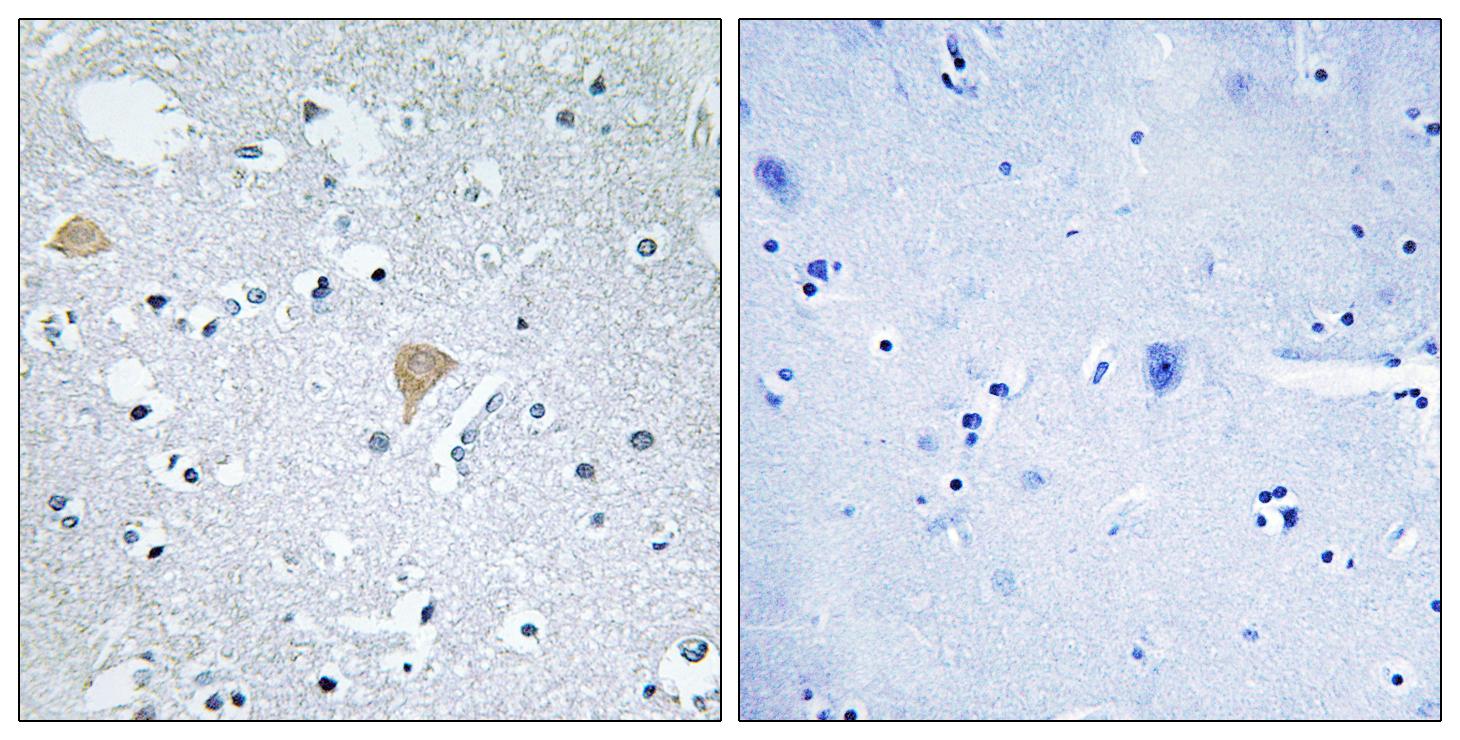
Immunohistochemistry analysis of paraffin- embedded human colon carcinoma, using PKA CAT (Phospho-Thr197) Antibody. The picture on the right is blocked with the phospho peptide.
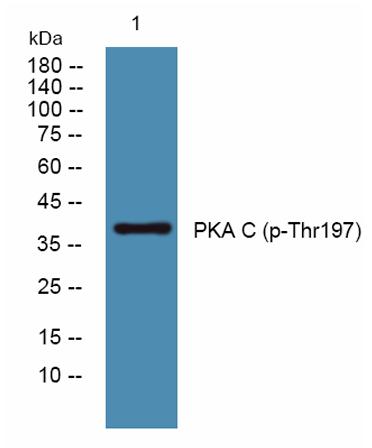
Western blot analysis of lysates from K562 cells, primary antibody was diluted at 1:1000, 4℃ over night.


Categories by research area
Categories by product type
- Antibodies
- Primary Antibodies
- Tag antibodies
- Internal control antibodies
- Pathological (Immunohistochemistry, IHC) antibodies
- Cell Signal Transduction Research Antibodies
- Secondary Antibody
- Antibody Sampler Kits
- ELISA Kits
- Recombinant Proteins
- Fluorescence Reagents
- Signal Inhibitors and Activators
- Transfection Reagent
- Cell biology kits
- Overexpression Cell Lines
- Cell Lysates
- Purification Resins
- 2019-nCoV & Monkeypox