
You are here: EnoGene Home > Products > Cell Signal Transduction Research Antibodies > Mouse anti-Human CD7, PE Conjugated mAb
Mouse anti-Human CD7, PE Conjugated mAb
Datasheet
Catalog Number:
E16HP007-050Amount:
50TestsForm of Antibody:
Phosphate-buffered solution, pH 7.4, containing 0.09% sodium azideStorage/Stability:
Store at 4°C.DO NOT FREEZE. LIGHT SENSITIVE MATERIAL.Background:
The eBio124-1D1 monoclonal antibody reacts with human CD7, also known as gp40 and Leu9. CD7, a 40 kD receptor, is a member of the immunoglobulin gene superfamily. The N-terminal amino acid sequence (aa1-107) is highly homologous to Ig kappa light chain sequence; while the carboxyl-terminal region of the extracellular domain is proline-rich and has been postulated to form a stalk from which the Ig domain projects. CD7 is expressed on the majority of immature and mature T lymphocytes, and T cell leukemias. It is also found on natural killer cells, a small suppopulation of normal B cells and on maligant B cells. Cross-linking surface CD7 positively modulates T cell and NK cell activity, as measured by calcium flux, expression of adhesion molecules, cytokine secretion and proliferation. CD7 associates directly with phosphoinositol 3'-kinase. CD7 ligation induces production of D-3 phosphoinositides and tyrosine phosphorylation.A clonogenic subpopulation of human CD34(+) CD38(-) cord blood cells that express CD45RA and HLA-DR and high levels of the CD7 has been reported. These cells possess the capacity for lymphopoiesis. They can generate B-cells, natural killer cells, and dendritic cells but do not possess the capacity to develop into myeloid cells or erythroid cells. The CD7(+) phenotype distinguishes primitive human lymphoid progenitors from pluripotent stem cells.Furthermore, it has been suggested that CD7 co-operates with CD28 during Treg function, as mice deficient in both CD28 and CD7 have reduced total numbers of Tregs and these Tregs have reduced suppressive activity.Isotype:
Mouse IgG1Clone Number:
eBio124-1D1Reactivity:
Human,Not yet tested in other species.Applications:
FCM IFExperimental Methods:
1.Take 100μl peripheral blood anticoagulated by EDTA and add to the bottom of 5ml tube;
2.Add 10μl labeled antibody to the bottom of flow tube mixing with the whole blood, incubate for 20 minutes at room temperature away from light;
3.Add 2 ml1×RBC lysis buffer, incubate for 10 minutes away from light after mixing, dissolve red blood cells (recommended: RBC lysing Solution 10×,Cat.: FXP001);
4.Sample tube is set to 1000 rpm centrifugation for 5 minutes, discard the supernatant;
5.Add 2 ml PBS wash buffer to resuspend the cells, then1000 rpm centrifugation for 5 minutes, discard the supernatant;
6.Add 0.5 ml PBS wash buffer to resuspend the cells and detect by flow cytometry (sample should be determined on the day on the machine and can also be added fixation overnight at 4 ℃ then measured).Notices:
1.Since applications vary, each investigator should titrate the reagent to obtain optimal results.
2.Caution: Sodium azide yields highly toxic hydrazoic acid under acidic conditions. Dilute azide compounds in running water before discarding to avoid accumulation of potentially explosive deposits in plumbing;
3.If the sample can not be timely analysis, please fixed;
4.For research use only, not for diagnostic or therapeutic use.References:
1.Lyman SD, Escobar S, Rousseau AM, Armstrong A, Fanslow WC. Identification of CD7 as a cognate of the human K12 (SECTM1) protein. J Biol Chem. 2000 Feb 4;275(5):3431-7.
2.Sato AI, Balamuth FB, Ugen KE, Williams WV, Weiner DB. Identification of CD7 glycoprotein as an accessory molecule in HIV-1-mediated syncytium formation and cellfree infection. J Immunol. 1994 May 15;152(10):5142-52. (124-1D1, FA, FC, PubMed)
3.Aruffo A, Seed B. Molecular cloning of two CD7 (T-cell leukemia antigen) cDNAs by a COS cell expression system.EMBO J. 1987 Nov;6(11):3313-6.
Profile of peripheral blood lymphocytes analyzed by flow cytometry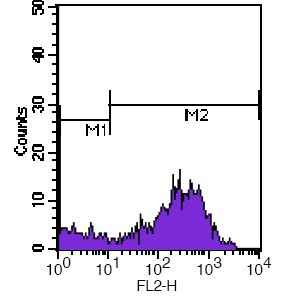
- Human peripheral blood lymphocytes stained with eBio124-1D1 PE
Price:
225$

Related Products

- PTEN (Phospho-Ser380) Antibody Datasheet
Catalog Number:
E011009-1Amount:
50μg/50μlReactivity:
Human, Mouse, RatApplications:
IHC: 1:50~1:100Swiss-Prot No.:
P60484Price:
145$

- PTEN (Phospho-Ser380) Antibody Datasheet
Catalog Number:
E011009-2Amount:
100μg/100μlReactivity:
Human, Mouse, RatApplications:
IHC: 1:50~1:100Swiss-Prot No.:
P60484Price:
225$

- NFκB-p65 (Phospho-Ser468) Antibody Datasheet
Catalog Number:
E011013-1Amount:
50μg/50μlReactivity:
Human, Mouse, RatApplications:
WB: 1:500~1:1000 IF:1:100~1:200Swiss-Prot No.:
Q04206Price:
145$

- NFκB-p65 (Phospho-Ser468) Antibody Datasheet
Catalog Number:
E011013-2Amount:
100μg/100μlReactivity:
Human, Mouse, RatApplications:
WB: 1:500~1:1000 IF:1:100~1:200Swiss-Prot No.:
Q04206Price:
225$

- Rel (Phospho-Ser503) Antibody Datasheet
Catalog Number:
E011020-1Amount:
50μg/50μlReactivity:
HumanApplications:
IF:1:100~1:200Swiss-Prot No.:
Q04864Price:
145$

Catalog Number
- Amount:50Tests
- Price:225$

Contact us
Categories by research area
Categories by product type
- Antibodies
- Tag antibodies
- Internal control antibodies
- Pathological (Immunohistochemistry, IHC) antibodies
- Cell Signal Transduction Research Antibodies
- Secondary Antibody
- Antibody Sampler Kits
- Recombinant Proteins
- Fluorescence Reagents
- Signal Inhibitors and Activators
- Transfection Reagent
- Cell biology kits