
NCX1 Rabbit Polyclonal Antibody
Datasheet
-
Catalog Number:
E28PT5103Amount:
100ulPrice:
255$Altername:
SLC8A1; CNC; NCX1; Sodium/calcium exchanger 1; Na(+)/Ca(2+)-exchange protein 1Gene Name:
SLC8A1Protein Name:
Sodium/calcium exchanger 1Applications:
WB,ELISAReactivity:
Human,Mouse,RatConcentration:
1 mg/mlFormulation:
Liquid in PBS containing 50% glycerol, 0.5% BSA and 0.02% New type preservative N.Human Gene Id:
6546Swiss-Prot No.:
P32418Mouse Gene Id:
20541Mouse Swiss Prot No:
P70414Rat Gene Id:
29715Rat Swiss Prot No:
Q01728Immunogen:
Synthesized peptide derived from NCX1 . at AA range: 270-350Specificity:
NCX1 Polyclonal Antibody detects endogenous levels of NCX1 protein.Recommended Dilutions:
WB 1:500 - 1:2000. ELISA: 1:5000. Not yet tested in other applications.Predicted Molecular Weight:
108kDForm of Antibody:
LiquidStorage/Stability:
Shipped at 4°C. Upon delivery aliquot and store at -20°C for one year. Avoid freeze/thaw cycles.Source:
Polyclonal, Rabbit,IgGBackground:
In cardiac myocytes, Ca(2+) concentrations alternate between high levels during contraction and low levels during relaxation. The increase in Ca(2+) concentration during contraction is primarily due to release of Ca(2+) from intracellular stores. However, some Ca(2+) also enters the cell through the sarcolemma (plasma membrane). During relaxation, Ca(2+) is sequestered within the intracellular stores. To prevent overloading of intracellular stores, the Ca(2+) that entered across the sarcolemma must be extruded from the cell. The Na(+)-Ca(2+) exchanger is the primary mechanism by which the Ca(2+) is extruded from the cell during relaxation. In the heart, the exchanger may play a key role in digitalis action. The exchanger is the dominant mechanism in returning the cardiac myocyte to its resting state following excitation.[supplied by OMIM, Apr 2004],Tissue Expression:
Detected primarily in heart and at lower levels in brain (PubMed:1374913). Expressed in cardiac sarcolemma, brain, kidney, liver, pancreas, skeletal muscle, placenta and lung (PubMed:1476165).Cellular localization:
Cell membrane ; Multi-pass membrane protein .Signaling Pathway:
Calcium;Cardiac muscle contraction;Hypertrophic cardiomyopathy (HCM);Arrhythmogenic right ventricular cardiomyopathy (ARVC);Dilated cardiomyopathy;Function:
alternative products:Additional isoforms seem to exist,enzyme regulation:By ATP.,function:Rapidly transports Ca(2+) during excitation-contraction coupling. Ca(2+) is extruded from the cell during relaxation so as to prevent overloading of intracellular stores.,similarity:Belongs to the sodium/potassium/calcium exchanger family. SLC8 subfamily.,similarity:Contains 2 Calx-beta domains.,tissue specificity:Cardiac sarcolemma.,Purification:
The antibody was affinity-purified from rabbit antiserum by affinity-chromatography using epitope-specific immunogen.-
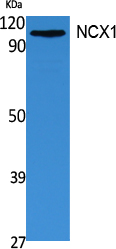
- Western Blot analysis of extracts from 293 cells, using NCX1 Polyclonal Antibody.. Secondary antibody was diluted at 1:20000

Related Products
Catalog Number
- Amount:100ul
- Price:255.00$

Contact us
Categories by research area
Categories by product type
- Antibodies
- Tag antibodies
- Internal control antibodies
- Pathological (Immunohistochemistry, IHC) antibodies
- Cell Signal Transduction Research Antibodies
- Secondary Antibody
- Antibody Sampler Kits
- Recombinant Proteins
- Fluorescence Reagents
- Signal Inhibitors and Activators
- Transfection Reagent
- Cell biology kits
Technical Support
- Westem Immunblotting Protocol(Primary Ab Incubation InBSA)
- Immunohistochemistry Protocol(Paraffin)
- Immunofluorescence Protocols
Connect Us
- Skype: enogene
- Email: order@enogene.com