
HP1 gamma (8Y11) Rabbit Monoclonal Antibody
Datasheet
-
Catalog Number:
E28M5432Amount:
100ulCite ID#:
EN5542884Price:
295$Applications:
WB,IHC,FC,IPReactivity:
Human,Mouse,RatType:
Rabbit Monoclonal AntibodyStorage/Stability:
Shipped at 4°C. Upon delivery aliquot and store at -20°C for one year. Avoid freeze/thaw cycles.Altername:
Chromobox protein homolog 3; HECH; Heterochromatin protein 1 homolog gamma; HP1 gamma; Modifier 2 protein; CBX3; HP1 gamma;Gene Name:
CBX3Formulation:
Supplied in 50mM Tris-Glycine(pH 7.4), 0.15M NaCl, 40%Glycerol, 0.01% New type preservative N and 0.05% BSA.Human Gene Id:
11335Swiss-Prot No.:
Q13185Immunogen:
A synthetic peptide of human HP1 gammaRecommended Dilutions:
WB: 1:1000 IHC: 1:20 FC: 1:20-1:100 IP: 1:20Molecular Weight:
21kDaPredicted Molecular Weight:
21kDaForm of Antibody:
LiquidIsotype:
Rabbit IgGCellular localization:
Nucleus. Note=Associates with euchromatin and is largely excluded from constitutive heterochromatin May be associated with microtubules and mitotic poles during mitosis (Potential).Description:
Recognizes and binds histone H3 tails methylated at 'Lys-9', leading to epigenetic repression. May contribute to the association of the heterochromatin with the inner nuclear membrane through its interaction with lamin B receptor (LBR). Involved in the formation of functional kinetochore through interaction with MIS12 complex proteins.Function:
Seems to be involved in transcriptional silencing in heterochromatin-like complexes. Recognizes and binds histone H3 tails methylated at 'Lys-9', leading to epigenetic repression. May contribute to the association of the heterochromatin with the inner nuclear membrane through its interaction with lamin B receptor (LBR). Involved in the formation of functional kinetochore through interaction with MIS12 complex proteins. Contributes to the conversion of local chromatin to a heterochromatin-like repressive state through H3 'Lys-9' trimethylation, mediates the recruitment of the methyltransferases SUV39H1 and/or SUV39H2 by the PER complex to the E-box elements of the circadian target genes such as PER2 itself or PER1. Mediates the recruitment of NIPBL to sites of DNA damage at double-strand breaks (DSBs) (PubMed:28167679).-
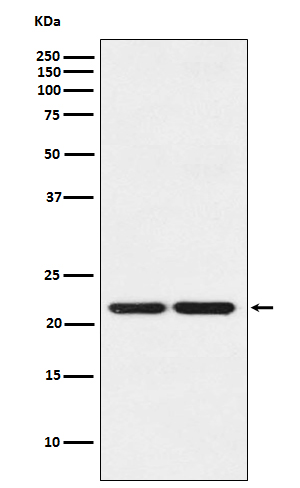
- Western blot analysis of HP1 gamma expression in (1) HeLa cell lysate; (2) NIH/3T3 cell lysate.

Related Products
Catalog Number
- Amount:100ul
- Price:295.00$

Contact us
Categories by research area
Categories by product type
- Antibodies
- Tag antibodies
- Internal control antibodies
- Pathological (Immunohistochemistry, IHC) antibodies
- Cell Signal Transduction Research Antibodies
- Secondary Antibody
- Antibody Sampler Kits
- Recombinant Proteins
- Fluorescence Reagents
- Signal Inhibitors and Activators
- Transfection Reagent
- Cell biology kits
Technical Support
- Westem Immunblotting Protocol(Primary Ab Incubation InBSA)
- Immunohistochemistry Protocol(Paraffin)
- Immunofluorescence Protocols
Connect Us
- Skype: enogene
- Email: order@enogene.com